


If you have ever looked out at a sea of blank faces during a training session or watched completion rates flatline on a course you poured weeks into, you know the quiet frustration. You find yourself wondering why people won’t just engage.
It is a lonely feeling. Usually, it is followed by a comfortable story we tell ourselves: some people are self-starters and some people are not. We file the disengaged under “unmotivated” and move on, secretly wondering if we could have done something differently.
Here is the reframe. The problem is almost never the learner. The problem is that we are asking them to be trait-motivated in a moment that calls for state motivation and our design is making it worse. This is not a criticism of your work. It is an invitation to stop blaming people for a design flaw.
The myth of the unmotivated person
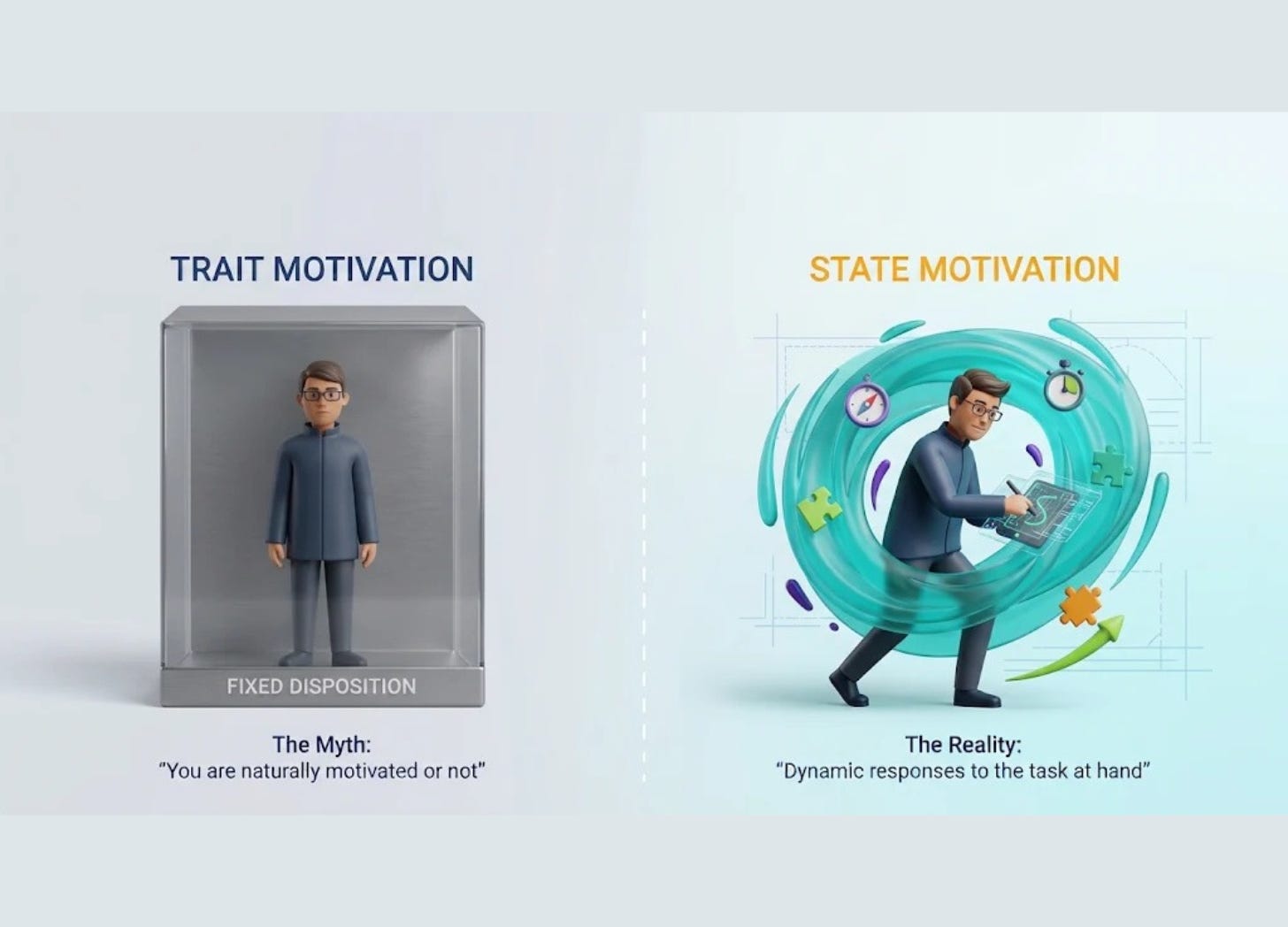
Most corporate learning and e-learning is built on a hidden assumption. We assume motivation is a stable personality trait. Either you are a motivated person or you are not.
The evidence disagrees. Researchers distinguish between trait motivation, which is a stable and enduring disposition and state motivation, which refers to dynamic and momentary responses tied to the task at hand. Both exist. They are not the same thing and they predict different outcomes. [jstage.jst.go.jp]
When researchers measured the correlation between trait and state motivation in a healthy sample, they found r=0.31. In plain English: your general disposition tells you something about how motivated you are likely to feel, but it leaves most of the variance unexplained. Your trait motivation predicts almost nothing about your motivation on a given Tuesday afternoon. [journals.plos.org]
Worse, when researchers compared the two directly, state motivation had stronger effects on achievement than trait motivation. What happens in the moment matters more than who the learner is in general.
Motivation is not a virtue. It is a calculation.

Neuroscience gives us a more useful and more compassionate model. Motivation is not a character quality. It is an effort-based decision where the brain weighs whether a potential reward is worth the effort required to obtain it. [ndcn.ox.ac.uk]
Dopamine plays a key role in energising behaviour and promoting willingness to exert effort. But dopamine is not a cheerleader that you either have or lack. It is part of a system that tracks the cost of effort in real time. That system is highly sensitive to context. Effort feels cheaper when a task is meaningful, when the path is clear and when the learner believes they are capable of succeeding. [ndcn.ox.ac.uk]
This is the heart of the shift. When a learner seems unmotivated, their brain may be making a perfectly rational calculation that the effort being asked of them is too high relative to the reward. Our job as designers is not to lecture them into wanting it more. It is to change the calculation.
How our designs accidentally ask for trait motivation
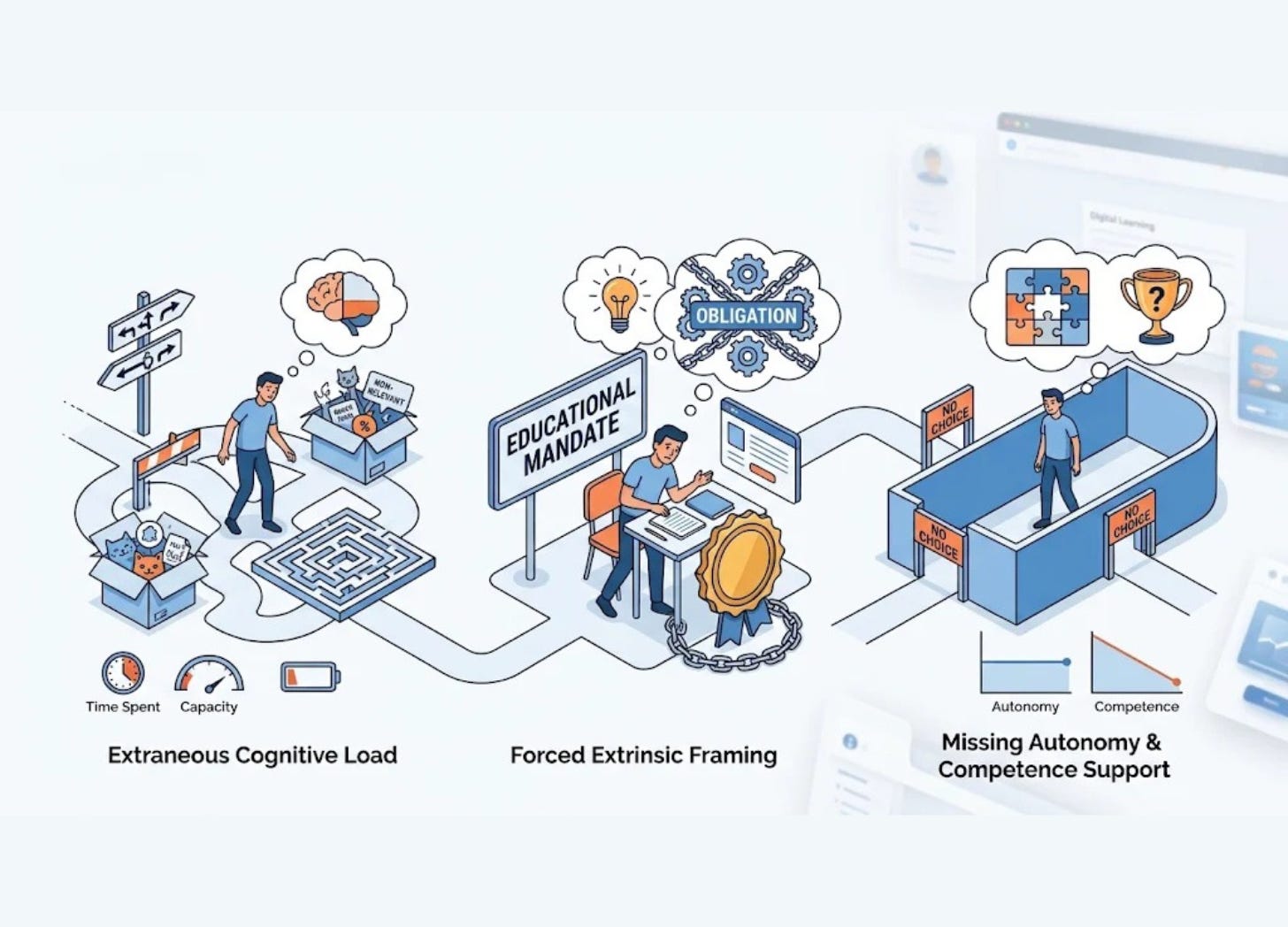
If motivation is state-dependent, then the learning environment becomes the primary lever. Yet many of our design choices assume the opposite. We assume learners should arrive pre-motivated and if they do not, that is their problem.
Three design patterns quietly demand trait motivation:
Extraneous cognitive load. When we load a course with confusing navigation, unclear instructions or irrelevant seductive details, we create unnecessary mental effort. Cognitive Load Theory distinguishes this extraneous load, which is caused by bad design, from the intrinsic difficulty of the material itself. Extraneous load depletes the exact cognitive resources a learner needs to feel capable. When the interface is exhausting, the brain decides the effort is not worth it.
Forced extrinsic framing. A striking study found that simply telling learners this is an educational game and you are supposed to learn increased extraneous cognitive load. It actually decreased learning outcomes compared with letting them play for fun. When we over-signal the obligation, we crowd out the intrinsic interest that would have carried the learner forward. [sciencedirect.com]
Missing autonomy and competence support. Self-Determination Theory identifies three psychological needs that support intrinsic motivation: autonomy, competence and relatedness. In a workplace study, competence showed the strongest association with autonomous motivation. Autonomy showed the strongest association with the intention to keep learning. When our designs offer no meaningful choice and no clear evidence of progress, we starve the very needs that make effort feel worthwhile. [sciencedirect.com]
Three design levers that shift the state
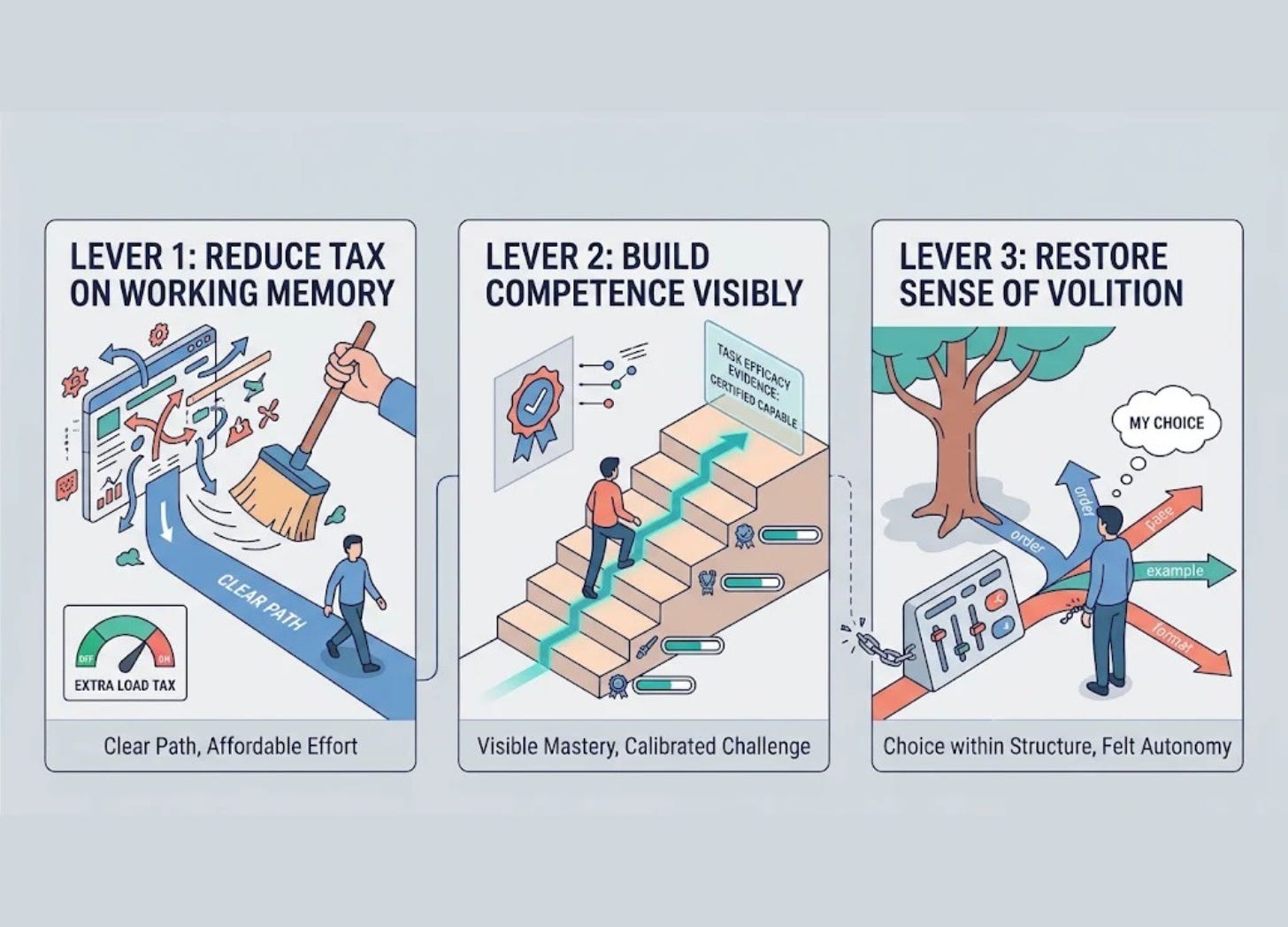
The good news is that state motivation is designable. You do not need to change who your learners are. You need to change what the moment asks of them.
Lever 1: Reduce the tax on working memory. Audit your course for extraneous load. Every unnecessary click, every unclear label and every decorative element that competes with the learning goal is a small withdrawal from the learner’s motivational account. The goal is making the effort feel affordable. When the path is clear, the brain is more willing to walk it.
Lever 2: Build competence visibly. Competence is not a feeling you tell people they have. It is a feeling you demonstrate to them. Gamification works when it supports this, not when it adds badges as a thin extrinsic layer, but when it uses progress, feedback and appropriately calibrated challenge to show the learner they are becoming more capable. Feedback that indicates task-efficacy is evidence, not a reward. [sciencedirect.com]
Lever 3: Restore a sense of volition. Autonomy does not mean abandoning structure. It means giving learners meaningful choices within that structure like the order of modules, the pace, the format of an assessment or the example they want to explore. When people feel they are acting from their own volition rather than being pushed, effort feels less like a cost and more like a choice.
The shift in identity
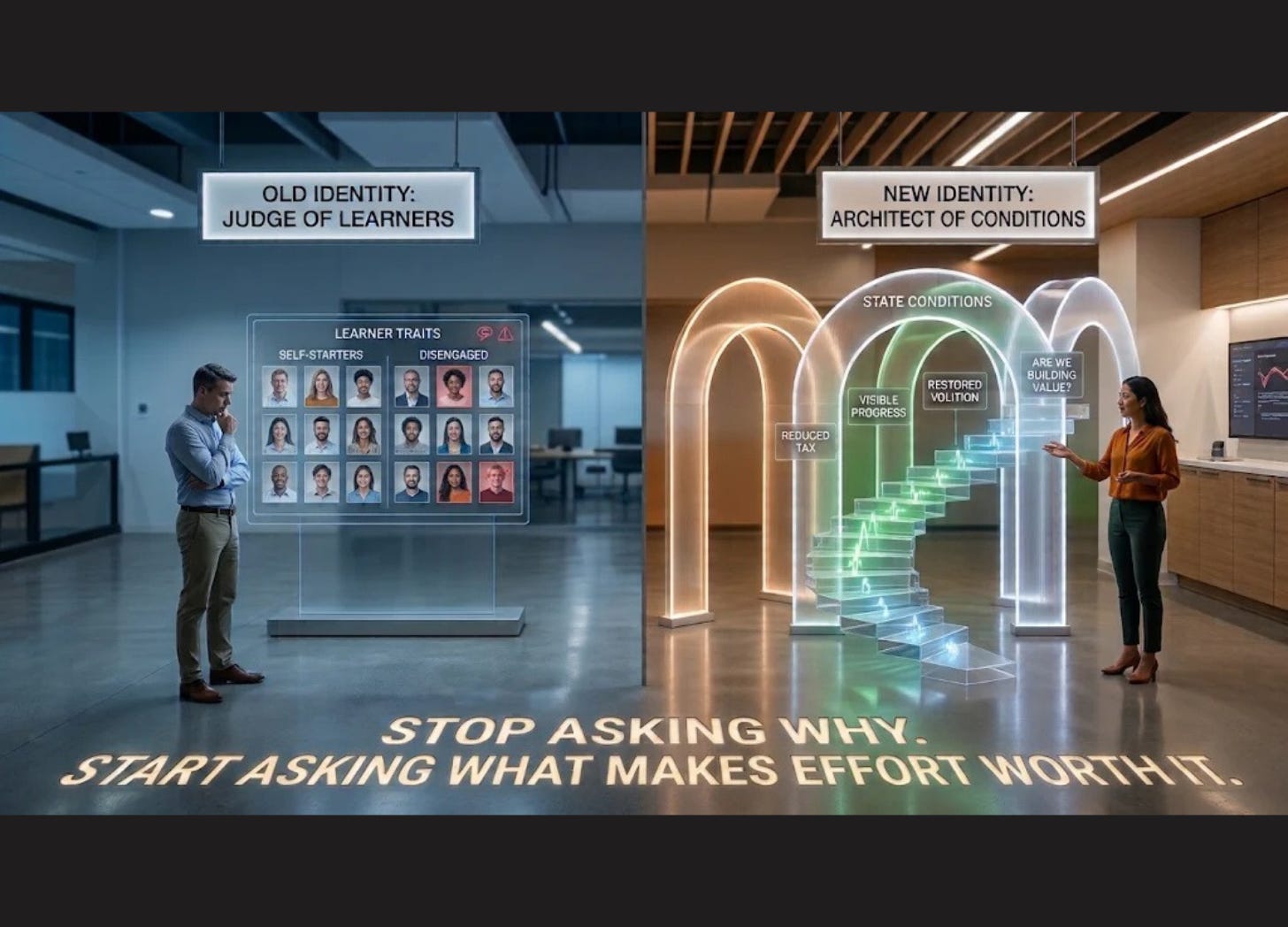
This is not just a tactical adjustment. It is a shift in what it means to be an instructional designer.
When we assume motivation is a trait, we become judges of learners. We sort the self-starters from the rest. We take disengagement personally or we write it off as someone else’s deficiency.
When we understand motivation as a state, we become architects of conditions. We stop asking why they are not motivated and start asking what is making effort feel expensive right now and what would make it feel worth it.
That question is more generous to the learner. It is also more honest about our own power. It is the question that actually changes the work.
State-Motivation Design Checklist
Audit extraneous load by removing unnecessary navigation, clarifying labels and cutting decorative content that does not serve the learning goal.
Make progress visible by showing learners what they have gained, not just what they have completed.
Calibrate challenge by matching difficulty to current competence so success is achievable but not trivial.
Offer meaningful choice by letting learners control pace, order or format where possible.
Frame feedback as evidence to demonstrate growing capability rather than just correcting errors.
Check the obligation signal to ensure you are not over-emphasising mandatory learning over genuine interest.