

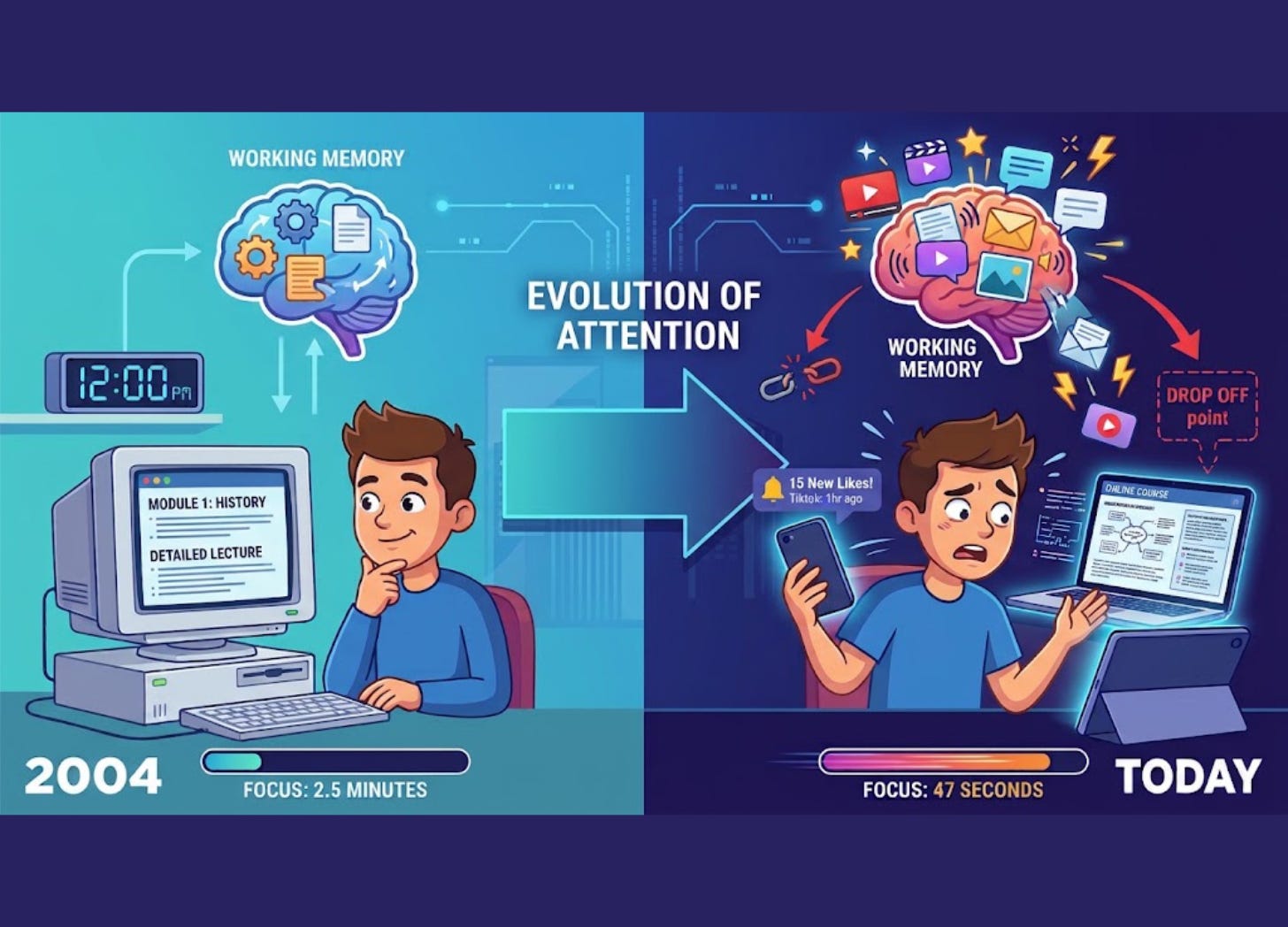
In 2004, the average person could look at a screen for about two and a half minutes before switching tasks. Today, research from Gloria Mark and her team shows that number has collapsed to roughly 47 seconds.
It is easy to blame shorter attention spans or lack of discipline. But if your online course is losing people in the first minute, you are not facing a motivation problem; you are facing a design problem. Most courses are still built for 2004, ignoring a critical bottleneck sitting right between the learner’s ears: working memory.
The 47-Second Reality
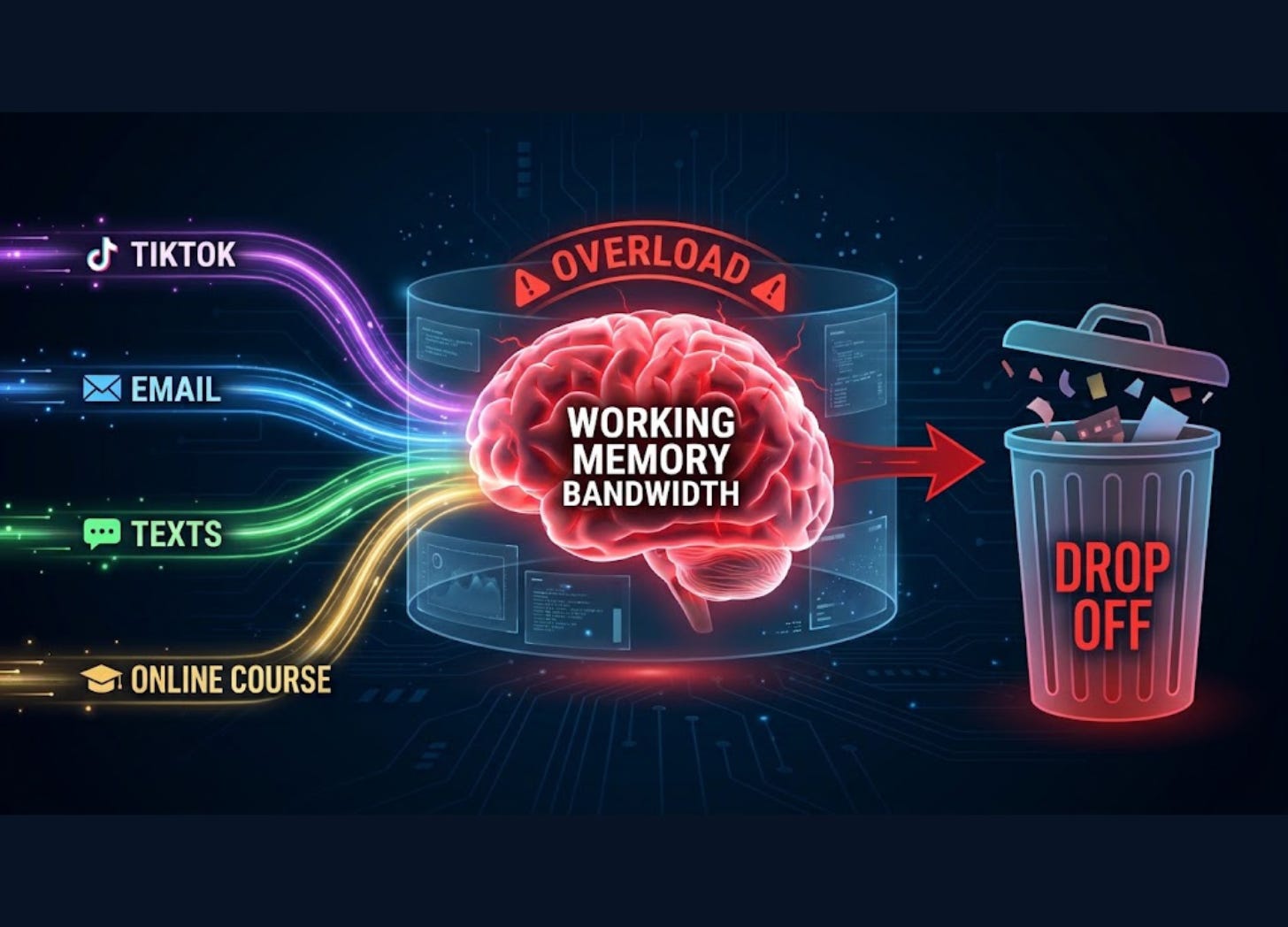
That drop from 2.5 minutes down to 47 seconds does not mean people have lost the capacity to focus. It means competition for their attention is fiercer than ever. Every second, a learner’s brain is running an invisible cost-benefit analysis, deciding whether whatever is on screen is worth its limited mental bandwidth.
Most courses lose that calculation almost immediately. It is not because the learner is lazy. It is because the course demands more from working memory than it can physically handle.
Your Working Memory Holds Four Things, Not Seven
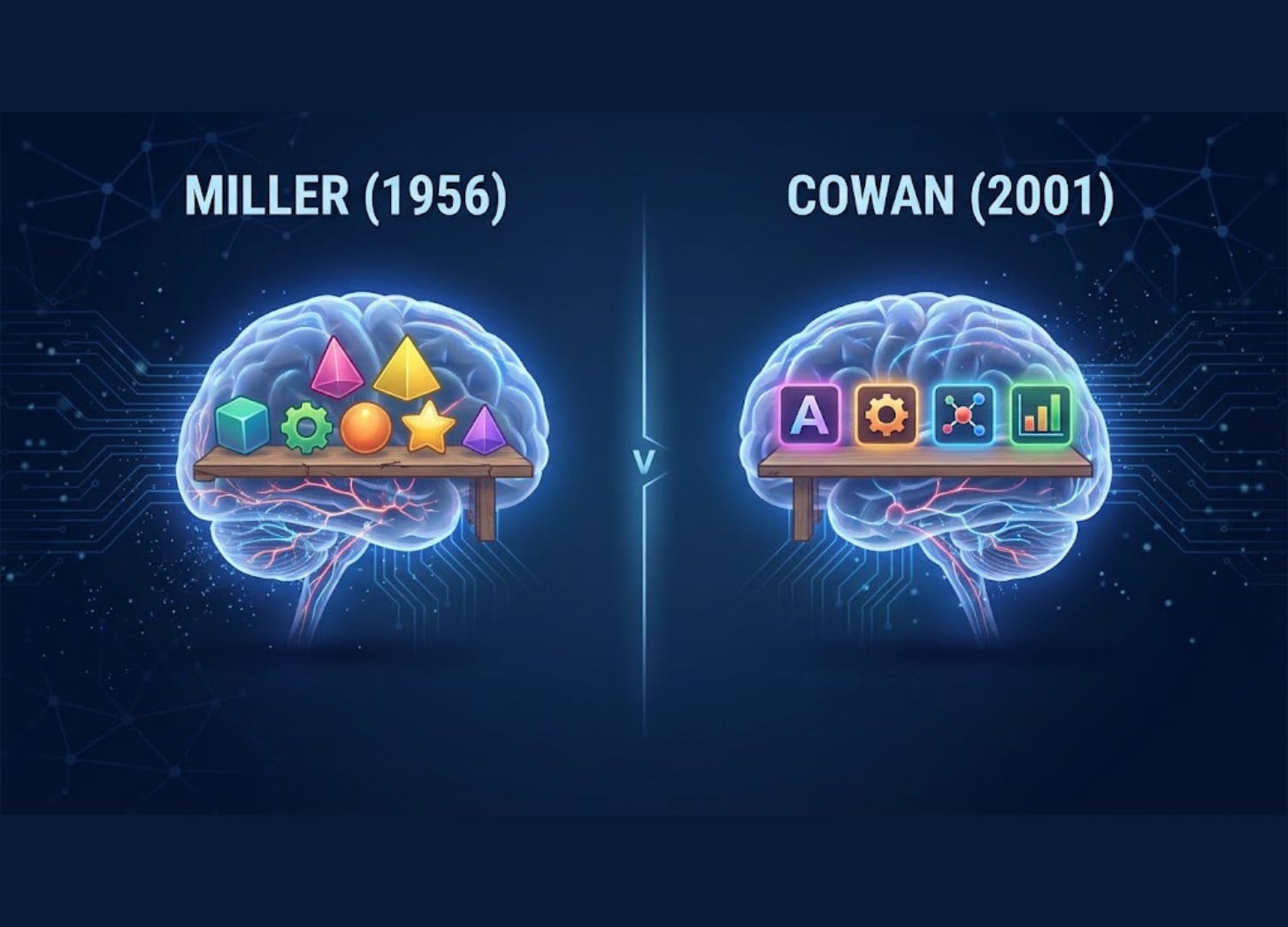
For decades, standard instructional advice relied on George Miller’s famous 1956 finding: the brain can hold 7 ± 2 items at once. It became an accepted rule of thumb in design.
It is also outdated.
In 2001, psychologist Nelson Cowan reviewed the evidence and found that pure working memory capacity in young adults is actually much smaller: closer to 4 ± 1 chunks. Four things, not seven and certainly not forty.
Working memory is the mental workbench where learning begins. You hold information there, process it and decide what to keep. If a course floods that workbench, the brain defaults to its natural survival mechanism: it drops items.
Inevitably, it drops the exact piece of information you needed the learner to remember.
Why Most Courses Overload the Brain
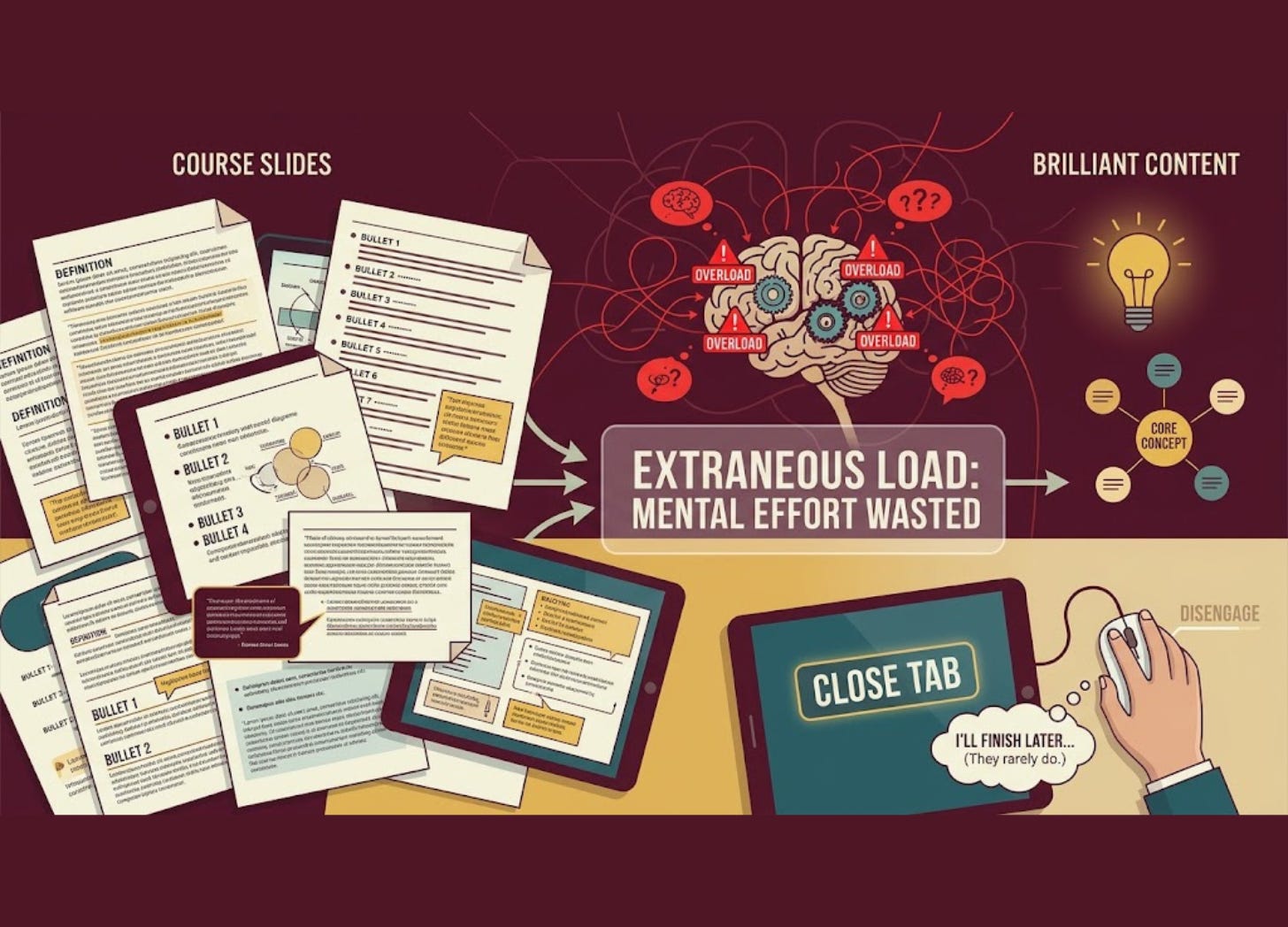
Look at a typical course slide: a text definition, three bullet points, an embedded diagram, a case study quote and a highlighted callout box.
Where the creator sees a rich, comprehensive resource, the learner’s working memory sees a massive traffic jam.
Cognitive scientist John Sweller called this extraneous load, which is mental effort wasted on processing poor presentation rather than absorbing the actual subject. The core content might be brilliant, but the packaging makes it almost impossible to process.
When working memory gets overwhelmed, learners do not just miss fine details. They disengage completely. They close the tab, promising themselves they will finish it later.
They rarely do.
The 2% Completion Problem Isn’t a Willpower Problem
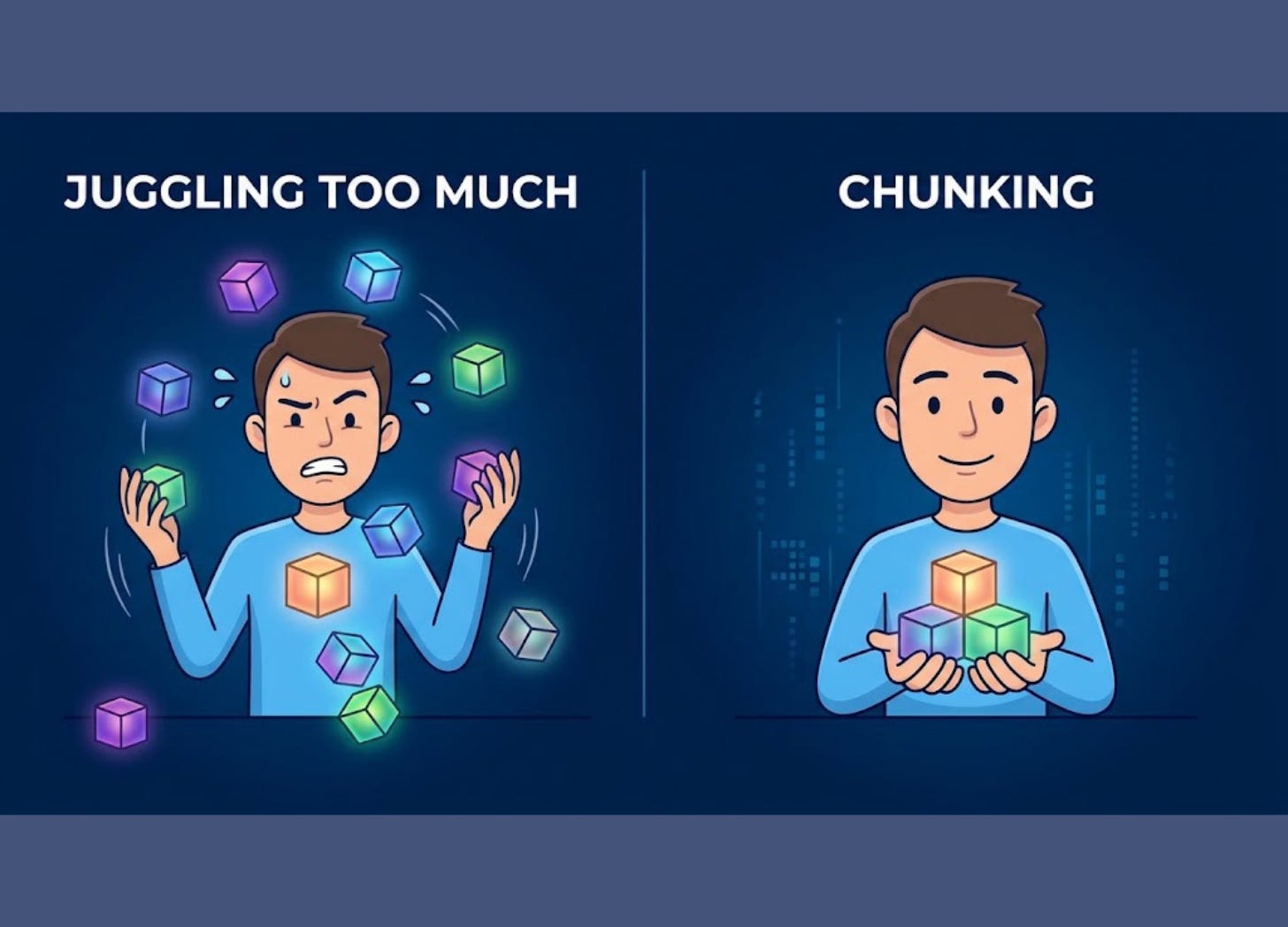
Completion rates for massive open online courses (MOOCs) consistently hover in the low single digits, often cited around 2%. While exact numbers fluctuate depending on the platform and course length, the underlying pattern is unmistakable: the vast majority of people drop out.
The easy explanation is to blame the learner’s self-control. A far more accurate explanation is cognitive load.
When every lesson forces someone to juggle too many new concepts at once, taking a course feels less like learning and more like an exhausting memory test. Learners do not need more willpower; courses need better chunking.
The Fix: One Concept Per Lesson
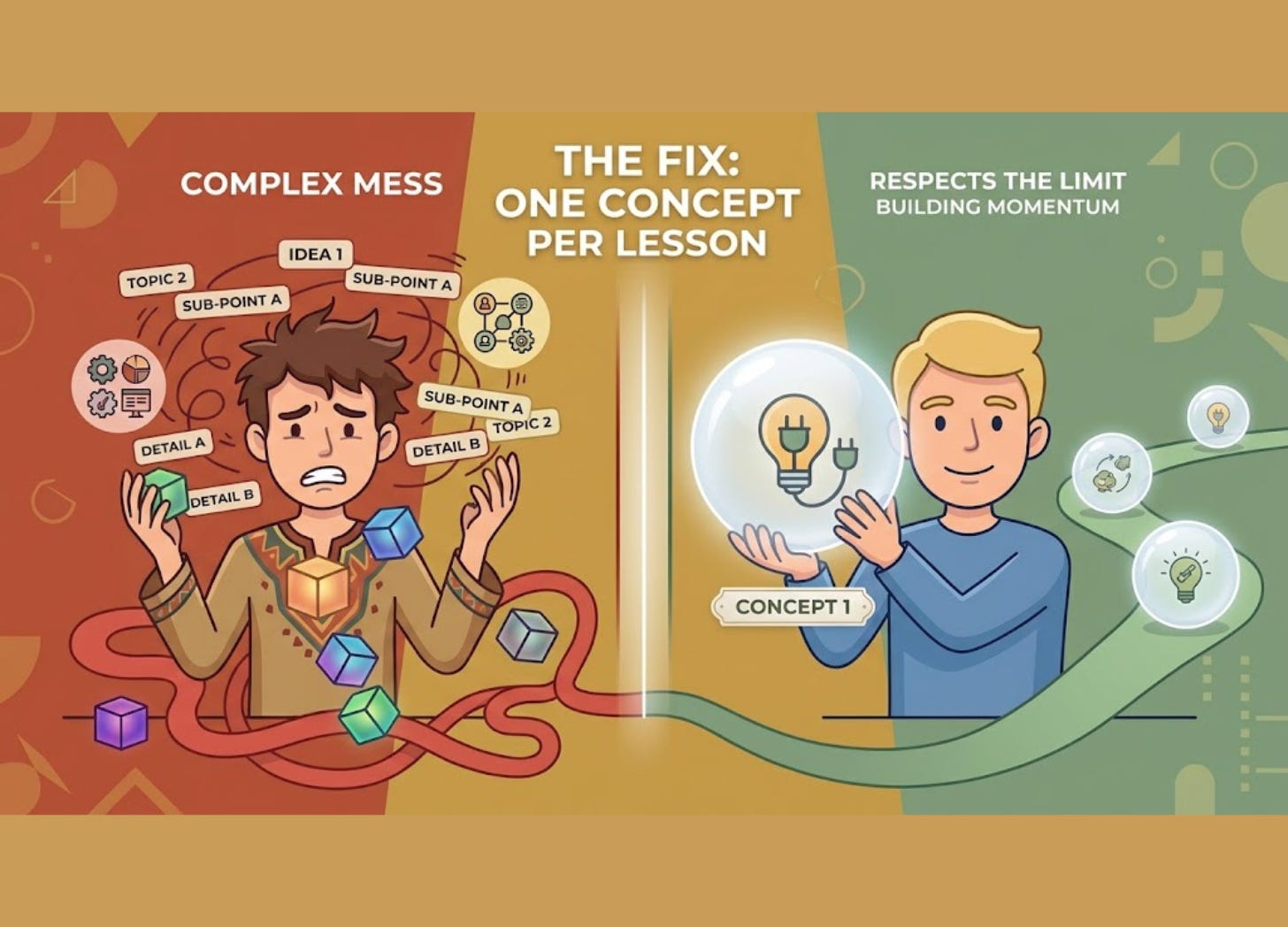
The solution is not complicated: limit each lesson to a single concept, consolidate it and move on.
Think of this not as a rigid rule, but as a practical design heuristic. It forces creators to answer an uncomfortable question during drafting: What is the one thing this lesson actually exists to teach? If the answer contains three separate ideas, you do not have one lesson; you have three.
Designing around chunks works because it respects the 4 ± 1 limit. By giving working memory a manageable load, consolidating it and only then moving forward, you create momentum. The learner gets quick wins, feels tangible progress and builds the confidence to keep going.
Instead of:
Dumping dozens of details at once
Crowding slides with text and visuals
Dragging learners through long theoretical intros
Vague promises like “By the end of this module, you’ll understand...”
Try:
Sticking to one core concept per lesson
Using one clear visual per idea
Delivering a single, concrete takeaway before moving on
Building a natural bridge from one chunk to the next
A Checklist for Course Creators
Before recording or publishing your next lesson, run it through this quick check:
One idea per lesson: If you cannot state the lesson’s core point in a single sentence, split the lesson up.
Clear progression: Introduce the single idea, unpack it, solidify it and stop.
Trim extraneous load: Strip away decorative graphics, redundant voiceover narration and competing screen elements.
Chunk intentionally: Bundle closely related facts into a single mental package.
Bridge your lessons: Frame transitions clearly (for example: “Now that we have covered the foundation, here is how it connects to our next step...”).
Design for the brain, not the presentation: Remember that working memory, not your slide deck, is the true interface.
Key Takeaways at a Glance
47 seconds: Current average screen attention before switching tasks.
2.5 minutes: The average screen attention time back in 2004.
4±1 items: Modern estimate of pure working memory capacity (Cowan, 2001).
7±2 items: Miller’s classic 1956 estimate, now considered an overestimate for pure capacity.
~2%: Widely cited MOOC completion rate, though actual figures vary.
The Heuristic: One concept per lesson.
The Bottom Line
A learner’s brain can reliably handle about four things at a time. If your lesson throws forty at them, the issue is not their focus; it is your architecture.
The fix does not require extra effort from the student. It requires better chunking from the creator. Design for the brain’s actual limits: one concept, one lesson, move on.
When a course respects cognitive limits, learners actually retain what they came for. That is not a memory miracle; it is just good design.
Great article Nandi! I find chunking really helpful too. Anytime, I go overboard, I don’t retain the information. This will be helpful for people who might not know about this.