


Retrieval practice means trying to bring information back from memory rather than reading it again. Research suggests that this effort can strengthen later recall. In classroom research, quizzing and other retrieval activities have generally shown positive effects compared with restudying, although results vary across subjects, learners and settings.[onlinelibrary.wiley][researchschool.org]
That does not mean every quiz works. A five-question multiple-choice check at the end of a module may show that someone can recognise a familiar answer. It may tell you very little about whether they can explain a policy, spot a risk or make the right decision at work.
For instructional designers, educators and L&D teams, the issue is simple: retrieval practice can support learning, but only when the activity matches what people need to remember and do. This article explains where quizzes go wrong, what stronger practice looks like and how to build checks that are worth a learner’s time. You can also download a free guide at the end.
So why can a quiz feel useful even when it has not helped someone learn?
Why a Quiz Can Feel Like Learning Even When It Is Not
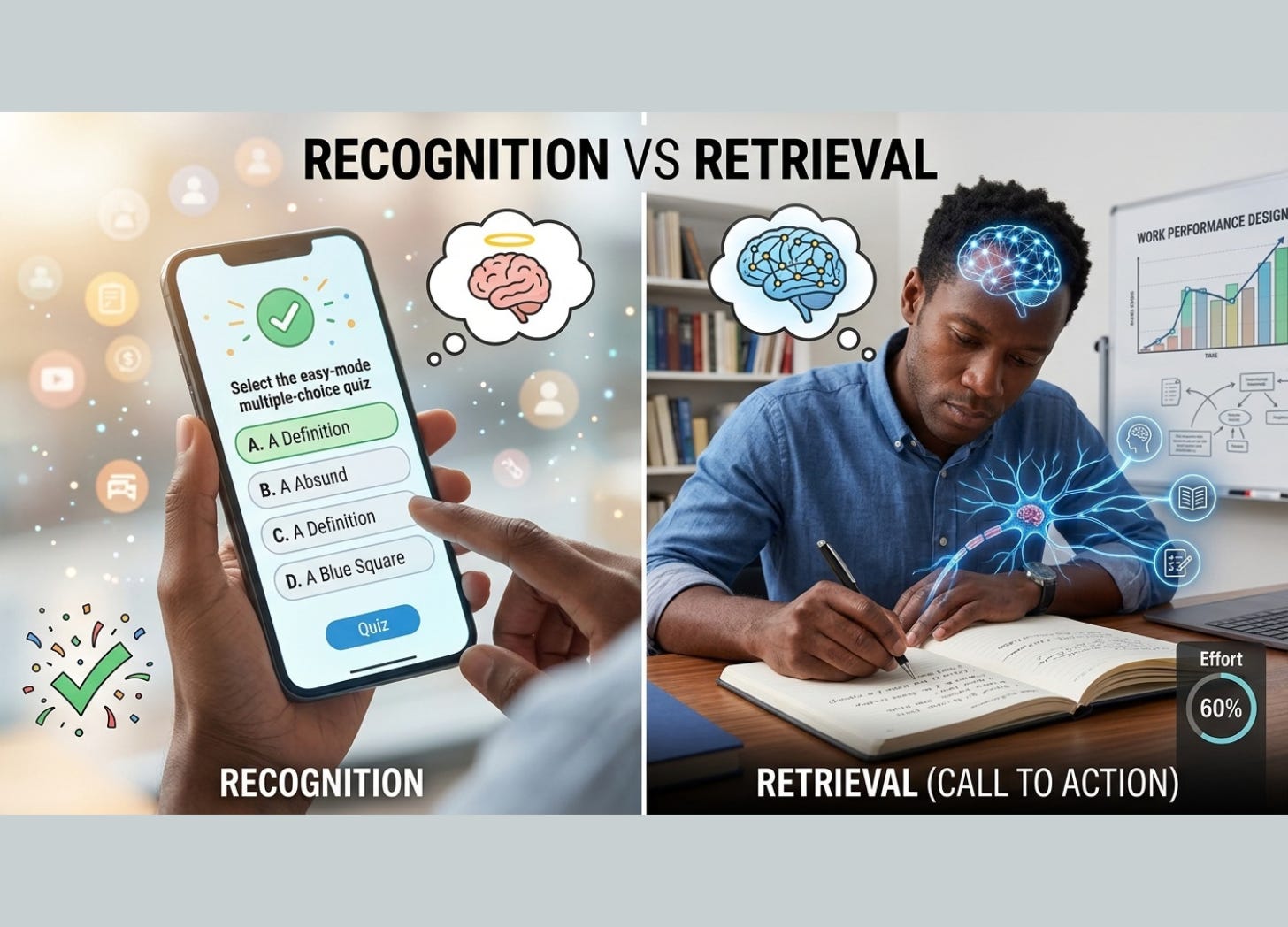
A familiar answer can create a powerful illusion. You see four options on screen, recognise one from the module you have just completed and select it. The platform gives you a green tick. Confetti appears. You move on.
It feels like learning because the answer is familiar. Yet familiarity is not the same as recall.
Think about hearing the first line of a song. You may recognise it within seconds. Singing the next line without hearing the music is harder. Recognition gives you clues. Retrieval asks you to produce the answer from memory with fewer clues.
That distinction matters in learning design. A learner may recognise a definition when it sits next to three incorrect answers. The same learner may struggle to explain the concept to a customer, use it during a meeting or apply it when a situation becomes unclear.
The Education Endowment Foundation explains that retrieval brings previously learned information back into working memory and can strengthen access to that knowledge later. It can also help learners identify what they do and do not yet know. Research summarised in a 2024 study found a medium average benefit for testing over restudying in both laboratory and classroom evidence, although the conditions of use matter.[onlinelibrary.wiley][educationendowmentfoundation.org]
This is why adding a quiz button is not enough. The question is whether the learner must think, retrieve and make a decision that resembles the knowledge or performance required later.
If that is the standard, what types of quiz design fall short?
What Poor Quizzing Gets Wrong
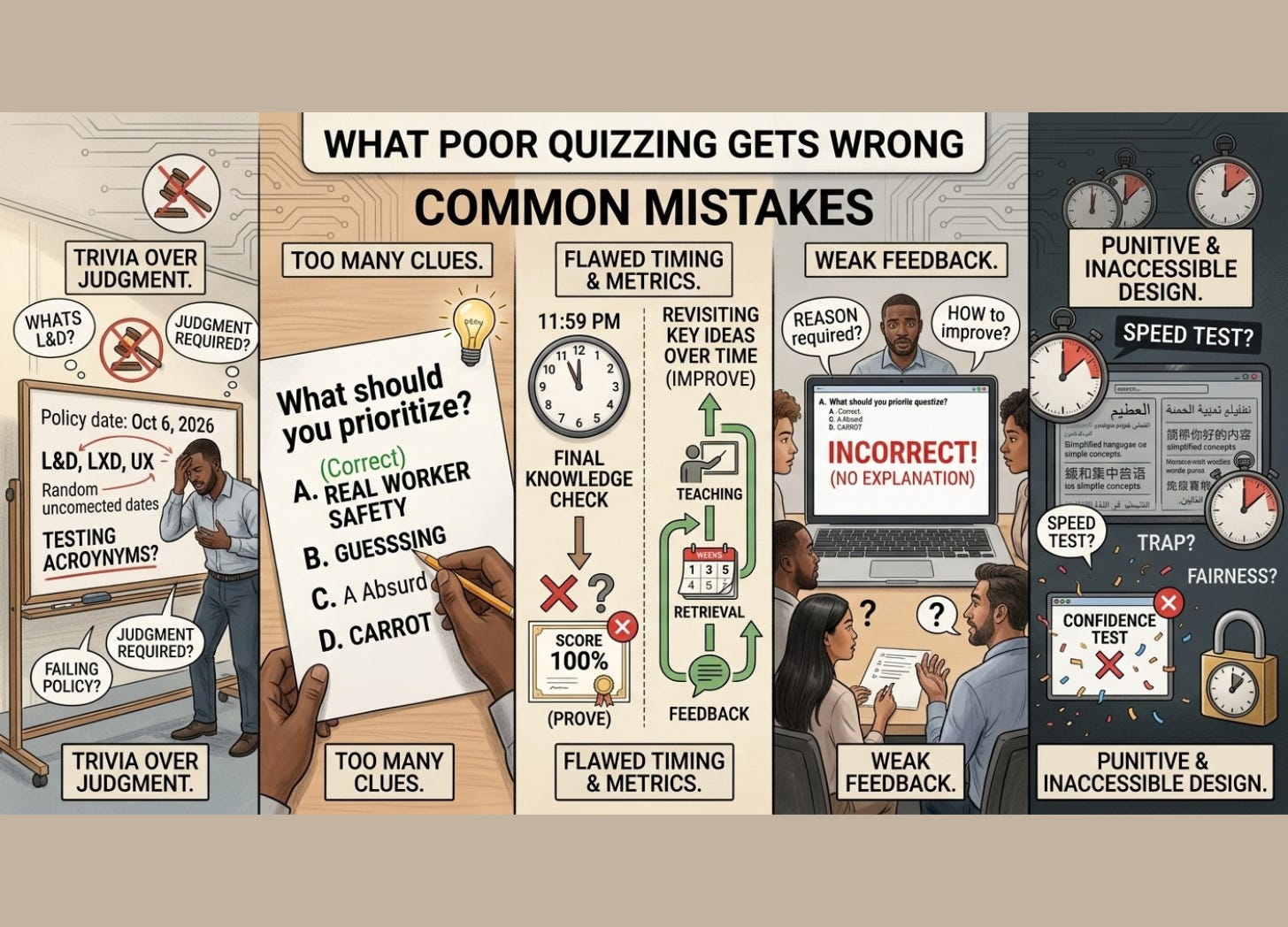
The problem with weak quizzes is rarely the quiz itself. It is the assumption that any question, at any point, with any feedback, counts as learning.
Here are common mistakes learning teams make.
Testing trivia instead of useful knowledge. A course may ask learners to recall a date, acronym or line from a policy while failing to test the judgement they need in a real situation.
Giving too many clues. A multiple-choice question can be useful, but it becomes too easy when one option is obviously correct or the wrong answers are absurd. The learner can guess without retrieving the knowledge.
Using questions only at the end. A final knowledge check may measure a short-term impression of learning. It does not give learners enough chances to revisit key ideas over time.
Treating scores as the outcome. A completion score tells you whether somebody selected the expected response. It does not prove that they can act safely, accurately or confidently in their role.
Giving feedback that says only “correct” or “incorrect.” Corrective feedback can matter. Research discussed in the retrieval-practice literature suggests that feedback can reduce the problem of low initial success and increase the benefits of testing.[onlinelibrary.wiley]
Making the quiz a punishment. When learners experience a quiz as a trap, they may focus on passing rather than understanding. This can be especially difficult for people who are new to a role, returning to learning after time away or studying in a second language.
Ignoring accessibility. Timed questions, unclear instructions, dense wording and interaction-heavy formats can measure speed, confidence or digital familiarity rather than knowledge.
The evidence also needs careful interpretation. The EEF warns against seeing retrieval as occasional quizzes or cold-call questions alone. Its guidance stresses that cognitive science principles need to be understood in depth and applied with attention to subject, setting and learner needs.[educationendowmentfoundation.org][educationendowmentfoundation.org]
This matters for fairness. A learner who gets a question wrong may need clearer teaching, more time, a worked example or a chance to practise in context. A low score does not automatically mean a lack of ability or effort.
So what would retrieval practice look like if it was designed to help people improve rather than simply prove they were paying attention?
How to Turn a Quiz Into Useful Practice
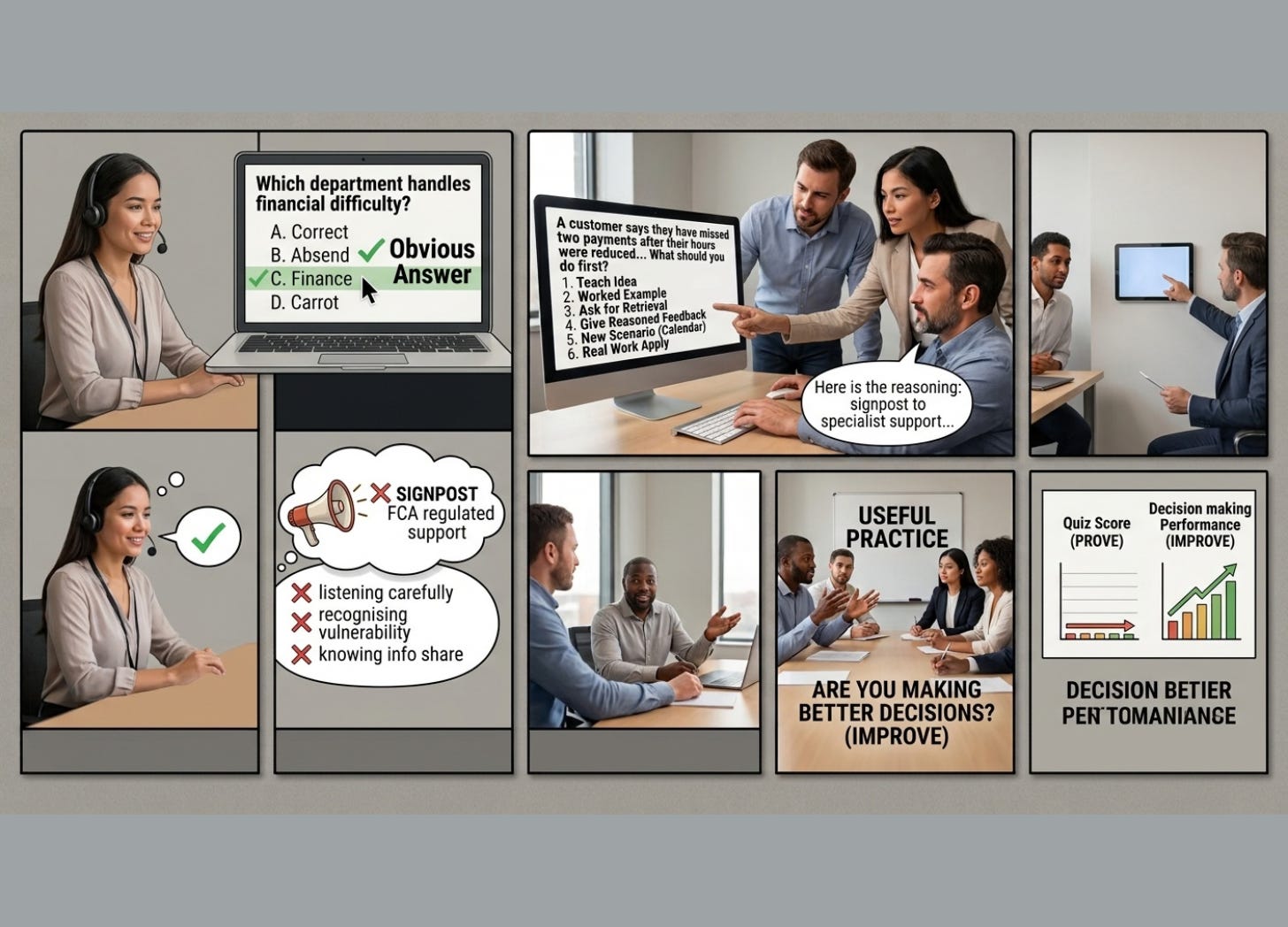
Imagine a short digital module on handling a customer who says they are struggling to keep up with essential payments.
A weak knowledge check might ask:
Which department handles financial difficulty?
A. Marketing
B. Customer support
C. Finance
D. Human resources
The learner may choose the obvious answer. They get a point. But the question has not tested the skills that matter: listening carefully, recognising possible signs of vulnerability, knowing what information is safe to share and understanding when to signpost someone to FCA-regulated support.
A stronger activity could give the learner a realistic scenario:
A customer says they have missed two payments after their hours were reduced. They are worried about losing their home and ask whether there is any support available. What should you do first?
The learner chooses a response, reads focused feedback and sees why the decision matters. A few days later, the course presents a different scenario that requires the same principle in a new context. The learner has to retrieve the approach rather than repeat a memorised line.
That creates a more useful sequence:
Teach the core idea in clear language.
Show a worked example of the right decision.
Ask the learner to retrieve the idea soon after.
Give feedback that explains the reasoning.
Return to the idea later in a changed scenario.
Check whether the learner can apply it during realistic work.
This approach also helps learning teams avoid a common mistake: using retrieval practice for everything. Retrieval can help with remembering information. It may not be the best first approach when learners need to solve a new or complex problem. Evidence discussed in retrieval-practice research suggests that worked examples can be more effective than retrieval when the desired outcome is problem-solving rather than recall.[alexquigley.co]
The goal is not to fill every screen with questions. The goal is to create a learning experience where people can practise the decisions they will later need to make.
Picture the difference six weeks after training. In one organisation, staff completed a module, passed an easy quiz and have forgotten much of the detail. In another, staff revisited key knowledge through short scenarios, received helpful feedback and practised decisions that reflected their real work. The second team has a stronger chance of recognising the situation when it matters.
That is the real test. Are your quizzes designed to produce a score, or to help people make better decisions when the course is over?
Build Checks That Earn Their Place

Retrieval practice can be a valuable part of learning design. It is not a magic button. The quality of the question, the timing, the feedback and the connection to real performance all shape whether it helps.
Before you add a knowledge check, ask:
What does the learner need to remember later?
What decision or task will that knowledge support?
Does the question require recall or only recognition?
Will the feedback help the learner understand the reasoning?
Will they revisit this knowledge after the course?
Is the activity clear and accessible for the people taking it?
For a free practical resource, download my Substack guide: 10 Evidence-Informed Ways to Use Knowledge Checks Without Wasting Learners’ Time. It includes question prompts, feedback examples and a simple review checklist for digital learning content.
Next, read: What Is Learning Experience Design—and Why Does UX Matter? It explores why useful training depends on more than accurate content. Learners also need an experience that is clear, accessible and designed around the way they actually work.
FAQs
1. What is retrieval practice?
Retrieval practice is the act of bringing information back from memory. It can include answering a question, explaining an idea, completing a scenario, using flashcards or recalling steps in a process. The key feature is effortful recall rather than simply rereading information.[educationendowmentfoundation.org]
2. Is retrieval practice the same as a quiz?
No. A quiz can be a form of retrieval practice, but only if it asks learners to retrieve useful knowledge. Retrieval can also happen through short-answer prompts, discussions, decision scenarios, teaching another person or practice tasks.
3. Does retrieval practice always improve learning?
No learning approach works equally well in every situation. Research generally supports retrieval over restudying, but effects vary by task, feedback, timing, subject and learner context.[onlinelibrary.wiley][researchschool.org]
4. Why are multiple-choice questions sometimes weak?
Multiple-choice questions can provide useful practice, but they may be too easy when learners can identify the answer from clues. They are stronger when distractors are plausible, feedback explains the reasoning and the question tests a meaningful decision.
5. Should learners receive feedback after every question?
Feedback is usually useful when it helps learners understand why an answer was correct or incorrect. A score alone is less helpful because it does not correct misunderstanding or explain how to improve.[onlinelibrary.wiley]
6. How often should retrieval practice happen?
There is no single universal schedule. A useful starting point is to give learners an early opportunity to retrieve information, then revisit it later through changed questions or scenarios. Distributed practice over time can support longer-term retention.[d2tic4wvo1iusb.cloudfront]
7. Can retrieval practice be used in workplace training?
Yes. It can be used in onboarding, compliance, product knowledge, customer-service training, leadership development and health and safety training. It works best when questions reflect the decisions and actions learners will need in their role.
8. Can gamification support retrieval practice?
It can, if game elements support meaningful practice. Progress markers, scenario challenges and useful feedback can encourage learners to return to key knowledge. Points, badges and leaderboards alone do not guarantee learning.
9. How can I make retrieval practice more inclusive?
Use plain language, avoid unnecessary time pressure, make instructions clear, ensure digital activities are accessible and provide feedback that helps learners improve. Design questions around the task rather than assumptions about learner ability.
10. What should I measure besides quiz scores?
Measure confidence with caution, task performance, error rates, quality of decisions, manager observations, customer outcomes and whether people can apply learning after time has passed. Completion and quiz scores are only part of the picture.
This was insightful. I generally don’t like quizzes because I tend to wing them but recall helps me retain the information. Good read Nandi!