

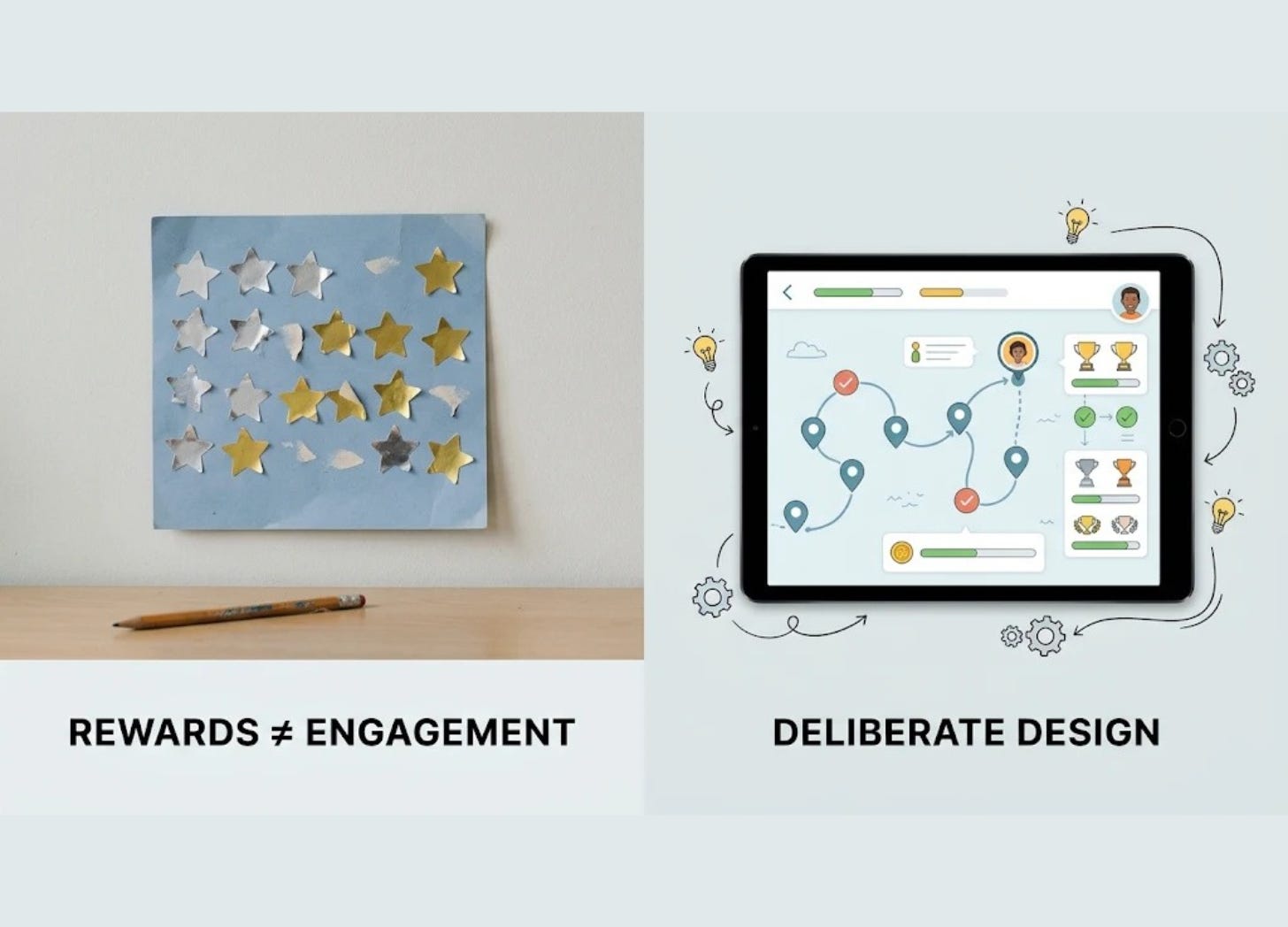
Picture a primary school classroom where a child gets a shiny star just for sitting quietly on the carpet. Now picture an office worker clicking through a mandatory data-privacy module and earning a digital trophy at the end. We call both of these things “gamification” all the time, yet neither of them actually is.
This quiet confusion sits right at the heart of one of education’s most overused buzzwords. True gamification isn’t about slapping shiny rewards onto a dull task and crossing your fingers that it suddenly feels fun. It is a deliberate design approach backed by a real evidence base and fraught with genuine ethical risks. When you are new to instructional design, understanding the difference between motivating learners and merely manipulating them matters enormously. Get it right and you build a learning experience that respects people’s intelligence. Get it wrong and you quietly teach them that the only reason to bother trying is to get the sticker.
So let’s untangle what gamification really means, where people get tripped up and why that distinction carries so much weight.
What gamification actually is
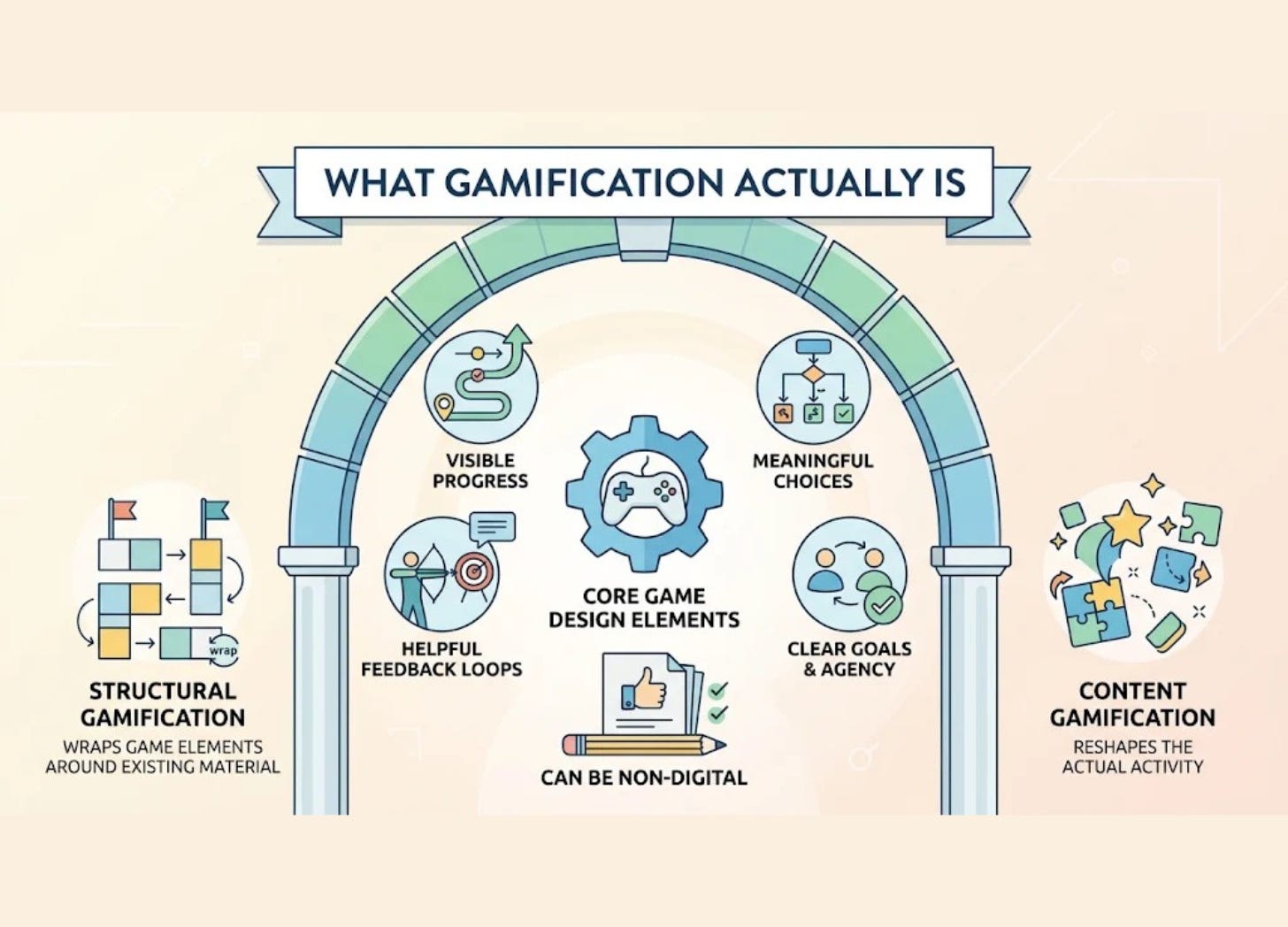
At its core, gamification means bringing game design elements into non-game settings to boost motivation, engagement and performance. Notice the emphasis on game design elements rather than full-blown games or the surface-level clutter of points and badges. You are borrowing the underlying mechanics that make games genuinely absorbing: clear goals, meaningful choices, visible progress, helpful feedback loops, fair challenges and a real sense of agency. [zenodo.org]
You also don’t need fancy software, an app or a massive budget to pull this off. A thoughtfully structured lesson on plain paper that gives learners real choices, shows them how far they have come and offers low-stakes feedback is completely gamified in spirit. Digital platforms are just delivery tools, not the magic ingredient. [zenodo.org]
It helps to separate two distinct approaches here. Structural gamification wraps game elements around existing material to help learners move through it without altering the lesson itself. Content gamification, on the other hand, reshapes the actual activity so the learning experience feels more like play. Both have their place, though only content gamification changes what the act of learning feels like from the inside. [zenodo.org]
Where people get it wrong
Because the word gets thrown around so loosely, it helps to clear up what gamification is not.
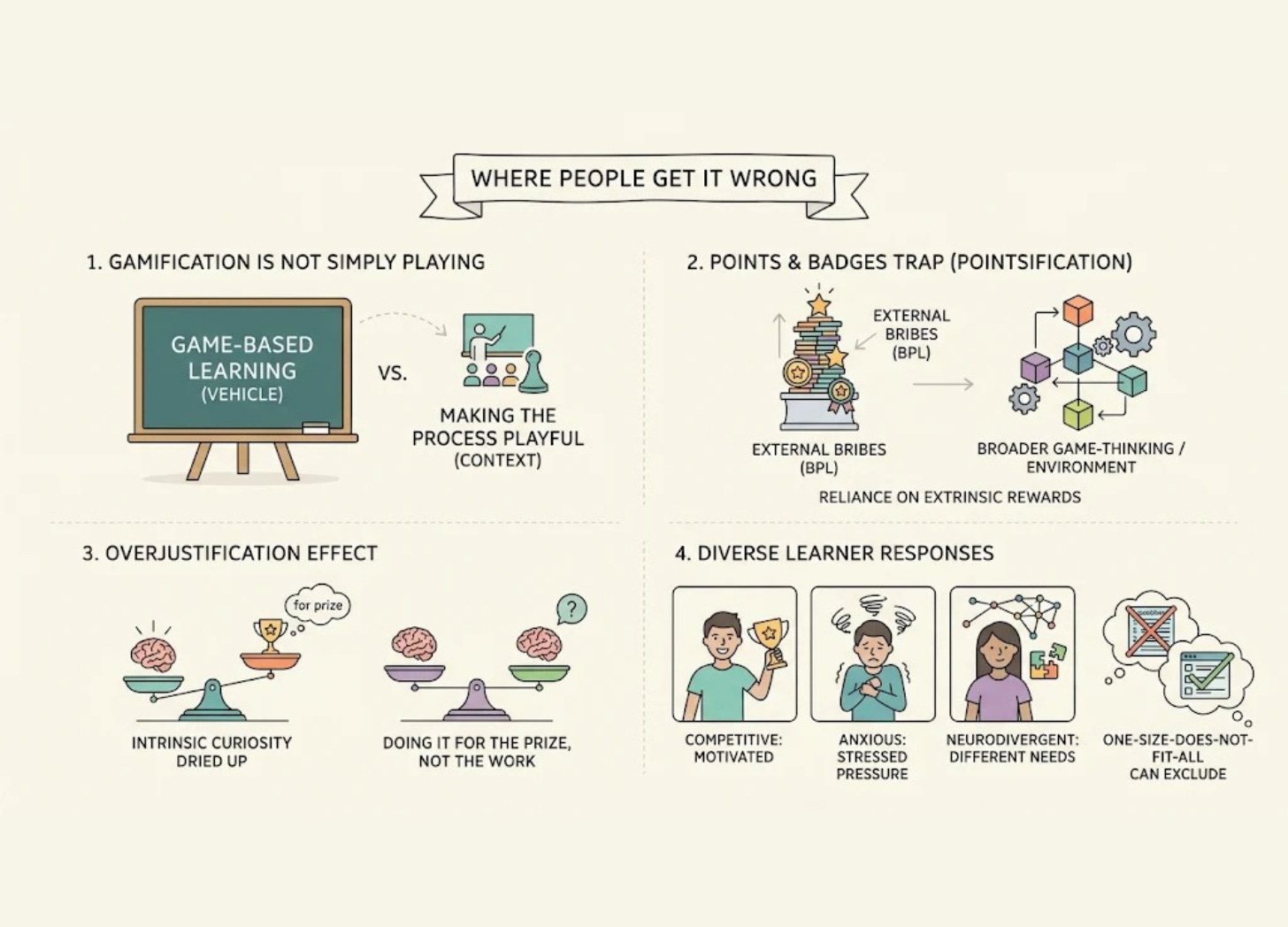
First, it isn’t just playing a game in class. When the game itself is the vehicle for teaching, you are doing game-based learning. Gamification simply makes the surrounding process more playful. Simulations aren’t gamification either and slapping a leaderboard onto a Friday afternoon Kahoot quiz doesn’t automatically make your lesson gamified. [zenodo.org]
Second and most importantly, gamification is not “pointsification.” This is the trap almost everyone falls into first: bolting points, badges and leaderboards onto an existing worksheet and calling it a day. Researchers actually treat pointsification as its own separate category because it relies entirely on external bribes to drive behaviour, whereas real gamification uses broader “game-thinking” to shape the whole environment. A classroom sticker chart is pointsification. An escape room that asks students to collaborate, recall facts and tackle escalating challenges is much closer to genuine gamification. The difference isn’t whether rewards exist, it’s whether thoughtful design is doing the heavy lifting. [frontiersin.org]
Third, piling on game mechanics doesn’t guarantee motivation and can actually backfire. If you dangle external rewards in front of learners for doing something they already found interesting, you risk triggering the overjustification effect. People start assuming they are only doing the work for the prize and their natural curiosity dries up. That is why the classic “badges, points and leaderboards” formula (often shortened to BPL gamification) keeps getting flagged in research as a shallow habit that destroys the exact engagement it tries to spark. [journal.seriousgamessociety.org]
Finally, gamification never hits every learner the same way. A public leaderboard might fire up your competitive students while sending anxious ones into a spiral. Daily streak counters can build healthy study habits for some people and feel like relentless, stressful pressure to others. Neurodivergent learners often bear the brunt of rigid, one-size-fits-all e-learning that ignores different cognitive and sensory needs and poorly planned gamification usually makes that exclusion worse rather than better. [eric.ed.gov]
Why this distinction actually matters
Separating gamification from pointsification isn’t just splitting hairs over vocabulary. It comes down to human psychology.
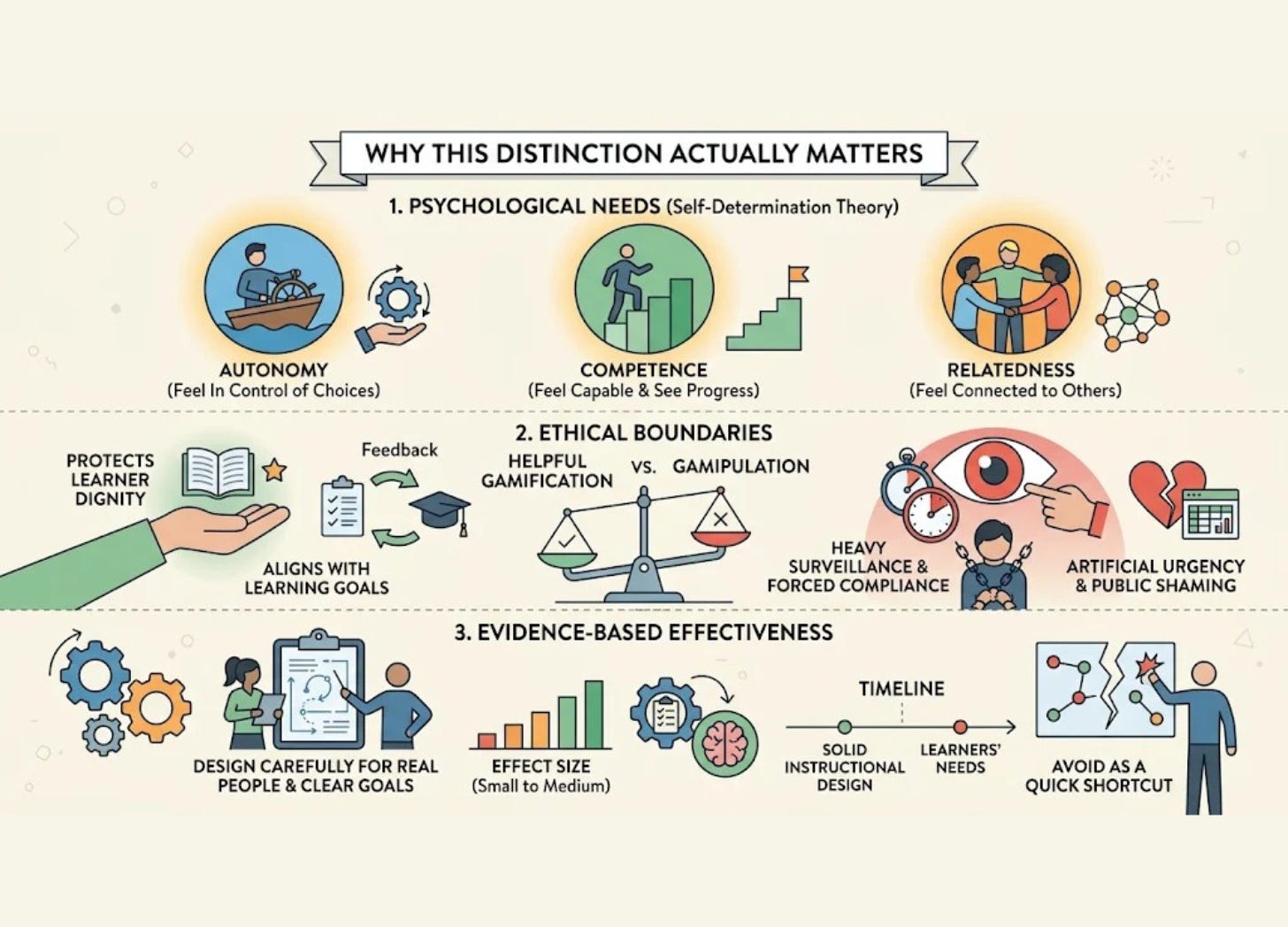
Self-Determination Theory, one of the sturdiest frameworks we have in motivation science, points out that people thrive when three core psychological needs are met: autonomy (feeling in control of your choices), competence (feeling capable and seeing your progress) and relatedness (feeling connected to others). When game elements nurture those three needs, intrinsic motivation flourishes. When they crush them through constant tracking, fake countdown timers, public ranking or controlling rewards, engagement falls apart. [scilit.com]
This is also where ethics enter the room. A recent framework draws a sharp line between helpful pedagogical gamification and “gamipulation,” which is the manipulative use of game mechanics to force compliance through heavy surveillance, artificial urgency, public shaming, punishment or endless external rewards. Ethical gamification ties mechanics directly to learning goals, protects learner dignity and uses feedback to build mastery. Gamipulation reduces human learning to obedience and spreadsheet metrics. [arxiv.org] [scilit.com]
If you look at the broader research, the reality sits somewhere between the breathless hype and the cynical backlash. A 2025 literature review found that gamification works best when solid instructional design principles ensure the material actually fits learners’ needs and expectations. Meta-analyses do show positive results, though the effects are often small to medium and messy study designs in the underlying research can muddy the waters. As a beginner, your safest stance isn’t claiming that gamification always works or never works. It works when you design it carefully for real people and clear goals and it backfires when you treat it as a shortcut. [springer.com] [seriousgamessociety.org]
What it is and what it is not: a quick comparison
It is bringing game design elements into non-game settings.
It is not playing a game in class or running a teaching simulation.It is a design mindset built on goals, choice, progress, feedback and challenge.
It is not simply adding points, badges and leaderboards (pointsification).It is something you can run on paper with zero tech.
It is not something that requires an app, software or a big budget.It is a way to nurture autonomy, competence and relatedness.
It is not a magic engagement button that works in every situation.It is aligned with clear learning outcomes and learner dignity.
It is not a behaviour-control system disguised as fun (gamipulation).It is built inclusively for diverse minds and needs.
It is not a rigid template that treats every learner identically.
A quick note on overlapping terms
Three phrases get muddled up constantly in education circles, even though they do very different jobs. Gamification weaves game elements into an existing learning process. Game-based learning makes the game itself the core learning activity. Serious games are full games built from scratch for a purpose beyond entertainment, like flight simulators or medical training games. You can gamify a history lesson without anyone ever playing a game and you can hand students a serious game without gamifying a single thing around it. Knowing which tool you are actually picking up is half the battle. [zenodo.org]
Before you add a single badge: a beginner’s checklist
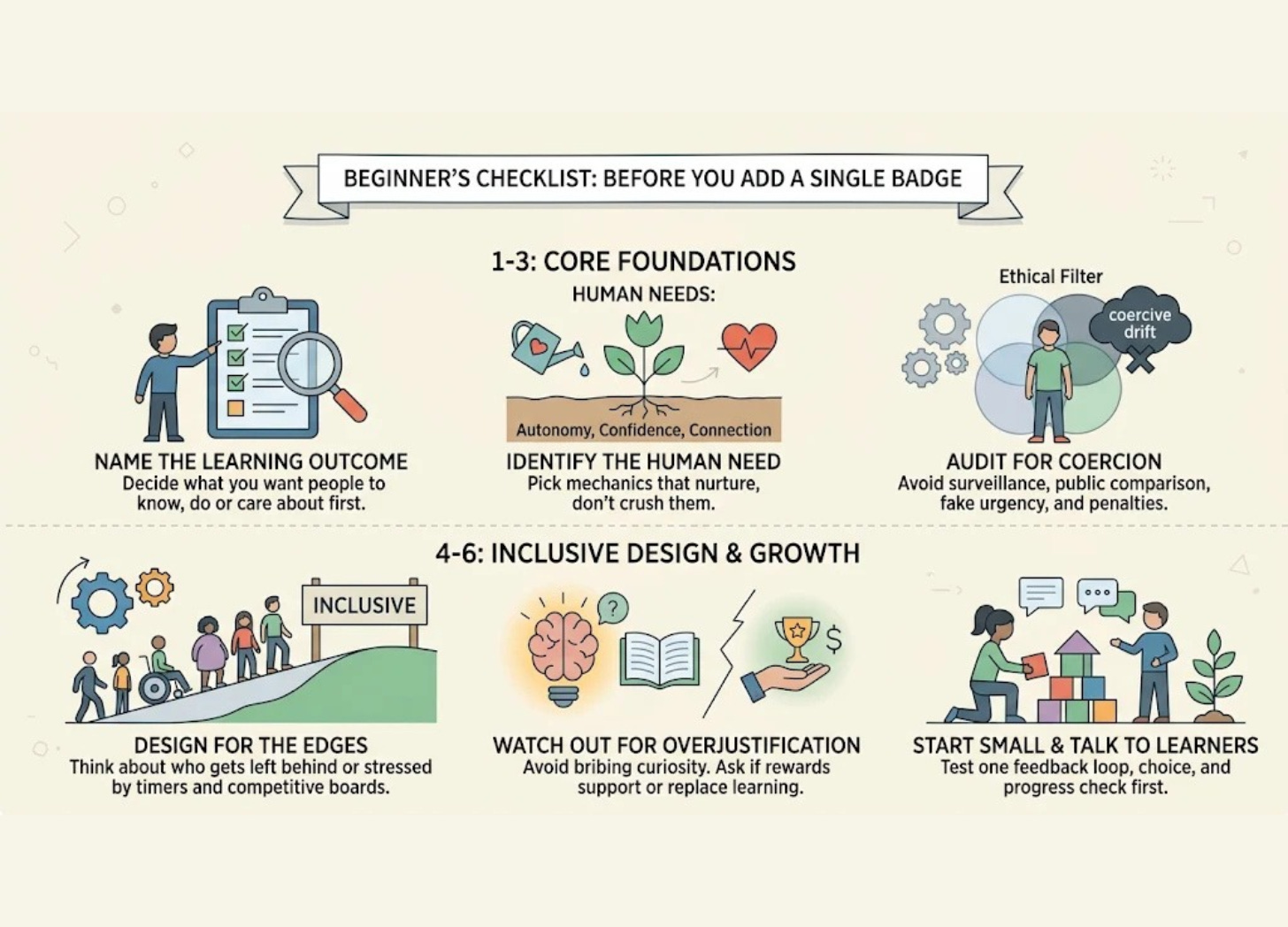
When you are starting out, it is wildly tempting to jump straight to the flashy stuff: the points, the badges and the leaderboards. Hold off for a minute and run through these six checks first.
Name the learning outcome first. Decide what you want people to know, do or care about by the end. If a game mechanic doesn’t help them get there, it is just clutter.
Identify the human need you are supporting. Are your learners lacking autonomy, confidence or peer connection? Different mechanics feed different needs and picking the wrong one can actively make things worse. [scilit.com]
Audit your design for coercion. Does your setup lean on surveillance, public comparison, fake urgency or penalties? If it does, you are drifting into gamipulation territory. [scilit.com]
Design for the edges rather than the average. Think about who gets left behind or stressed out by a timer, a streak or a competitive scoreboard. Inclusive gamification isn’t an optional extra; it has to be baked in from day one. [eric.ed.gov]
Watch out for the overjustification trap. If learners would happily explore this topic out of genuine curiosity, bribing them with rewards can kill that spark. Ask yourself whether your reward supports the learning or replaces it. [seriousgamessociety.org]
Start small and talk to your learners. You don’t need to build a sprawling digital ecosystem overnight. Try introducing one thoughtful feedback loop, one real choice and one clear way to see progress, then ask your learners how it actually felt. Good gamification is an ongoing craft, not a plugin you install once. [zenodo.org] [springer.com]
The question worth keeping
Whenever I look at a new lesson or training module, I try to skip past “Is this gamified?” and ask something much simpler: “What is this design asking the learner to care about?”
If the honest answer is the subject itself, the satisfaction of getting better and a sense of connection with the room, then the game elements are doing their job. If the answer is collecting points, chasing a badge or panicking about falling behind, something has slipped off track. You can always fix it, of course, but it helps to notice early.
Gamification isn’t a sticker chart. It is a decision to take learners seriously enough to design for their genuine curiosity rather than simply demanding their obedience. That takes a lot more thought than handing out digital trophies, yet it is also far more respectful and infinitely more likely to stick long after the novelty of the sticker wears off.