


Most adults already know how to learn, even if they don’t know why it works.
Think about the last time you taught yourself something useful. Maybe it was a new piece of software, a recipe you had never attempted or a clunky process at work that nobody bothered to explain properly. You probably didn’t go out and buy a textbook. You started with a problem you needed to solve, asked why it mattered and drew on what you already knew. More than anything, you wanted to be treated like a capable person rather than an empty vessel waiting to be filled.
That instinct isn’t random. It is the foundation of adult learning theory.
At its core, adult learning theory is a set of ideas about how grown-ups learn differently from children. The best-known version comes from an American educator named Malcolm Knowles, who popularised the term andragogy: “the art and science of helping adults learn”. The word sounds terribly academic, yet the idea itself is simple. Andragogy just asks educators to treat adults like adults. [collectionscanada.gc.ca]
This guide strips away the jargon to explain what the theory actually says, where the research pushes back and three practical ways you can use it today.
What adult learning theory actually says
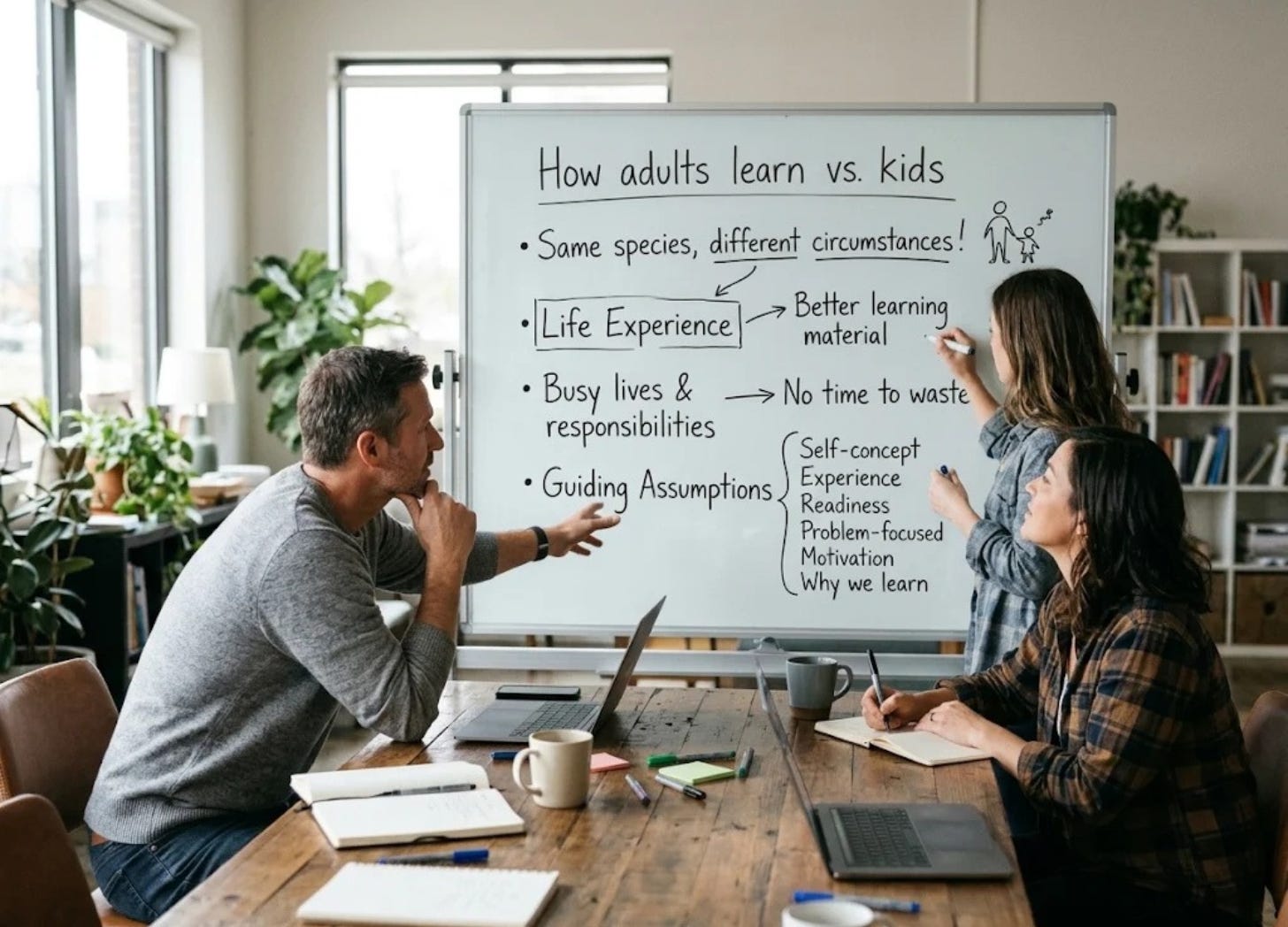
Knowles never argued that children and adults are completely different species. Instead, he noticed that adults tend to approach learning differently because of their life circumstances. By the time we reach adulthood, we have accumulated more experience, shouldered more responsibilities and developed far less patience for anything that feels like a waste of time.
The theory is usually broken down into six assumptions. Knowles was careful to call them guiding assumptions rather than rigid rules and they remain a useful starting point for anyone designing training, workshops or courses for grown-ups. [onlinelibrary.wiley.com]
The six assumptions without the jargon
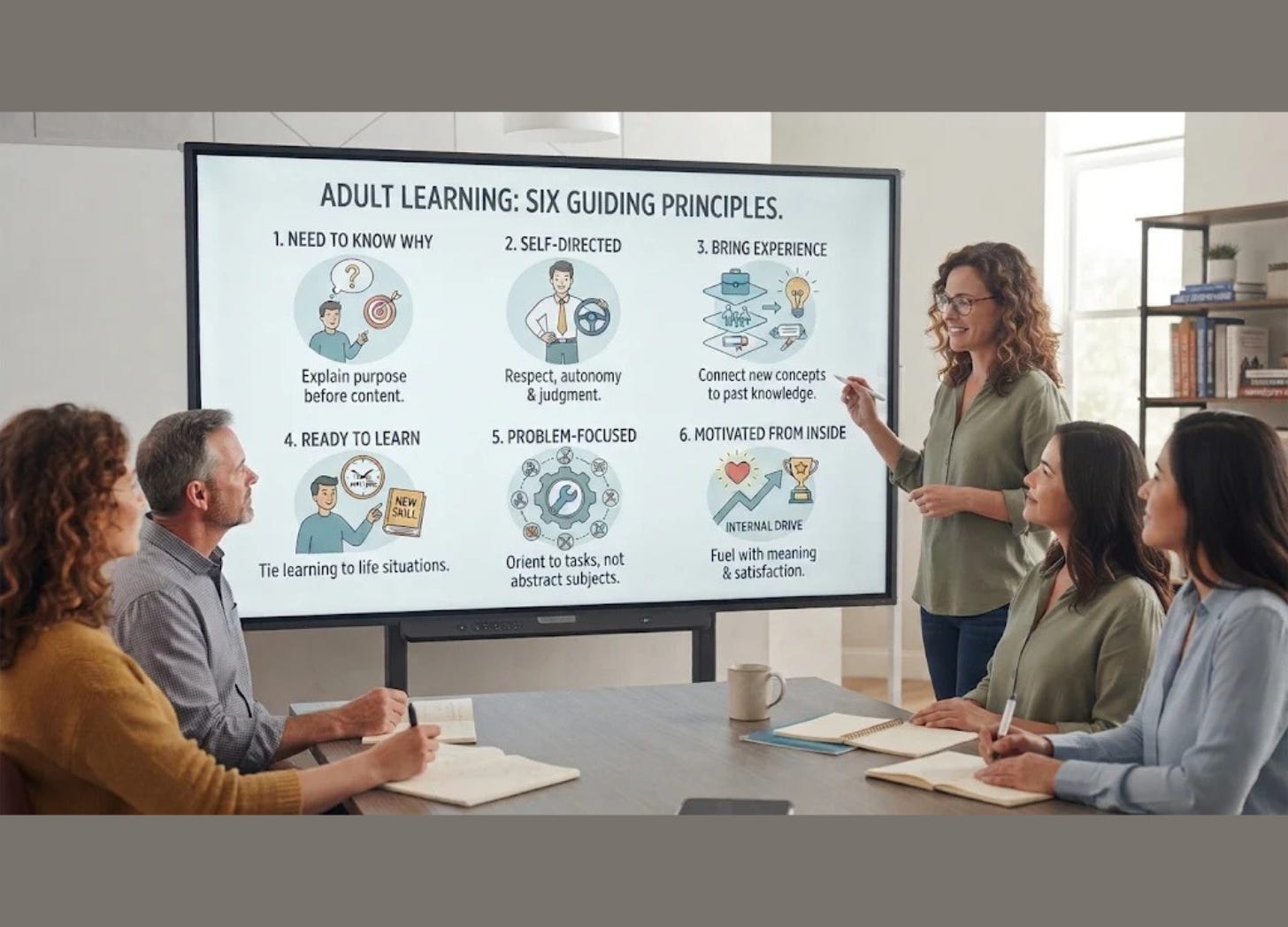
1. Adults need to know why. Before committing their time or energy, adults want to know the point. They silently ask: What is this for? What happens if I don’t learn it? How does this help me? Researchers call this the “need to know” and in practice it means explaining the purpose before diving into the content. A trainer who opens with “here is the theory” loses the room within five minutes. A trainer who opens with “here is the specific headache this solves” keeps everyone listening. [files.eric.ed.gov]
2. Adults see themselves as self-directed. Most adults believe they are responsible for their own lives and decisions, so they naturally resist being managed like schoolchildren. This doesn’t mean every adult wants to be left alone to figure things out in isolation. It simply means they want some say in the process and expect their judgement to be respected. [epale.ec.europa.eu]
3. Adults bring experience. Adults walk into every learning environment carrying a massive store of knowledge from work, family and life. Knowles called the learner’s experience “the richest resource for learning” and good training draws that out by connecting new ideas to what people already understand. That said, experience cuts both ways. Deeply ingrained habits can sometimes make new learning much harder, because people have to unlearn old routines first. [files.eric.ed.gov] [collectionscanada.gc.ca]
4. Adults learn what they are ready to learn. Readiness is almost always tied to real life. We become ready to learn things the moment we need them to cope with a shifting situation. A new parent suddenly cares deeply about infant sleep cycles, just as a newly promoted manager suddenly wants to understand how to give difficult feedback. Timing matters enormously and the exact same lesson can land completely differently depending on what is happening in someone’s life that week. [files.eric.ed.gov]
5. Adults learn for problems, not subjects. Children often learn subjects like history or algebra for their own sake. Adults tend to learn for immediate application. Our orientation is life-centred or task-centred, which means we want to know how a new skill helps us fix an issue right in front of us. Adult education works best when it is built around real tasks rather than abstract topics. [epale.ec.europa.eu]
6. Adults are motivated from inside. External rewards certainly matter; nobody turns down a better job or a higher salary. Still, Knowles argued that the strongest drivers are internal, including job satisfaction, self-esteem and a better quality of life. Adults stick with learning when it feels genuinely meaningful and they switch off the moment it feels like box-ticking compliance. [epale.ec.europa.eu]
Quick translation: Key terms
Andragogy: Adult learning theory or the art and science of helping adults learn.
Pedagogy: Teaching children, which was the traditional model andragogy was defined against.
Self-directed learning: Taking ownership of what you learn and how you go about it.
Assumptions: Practical starting points for design rather than proven scientific laws.
What the research says and where it pushes back
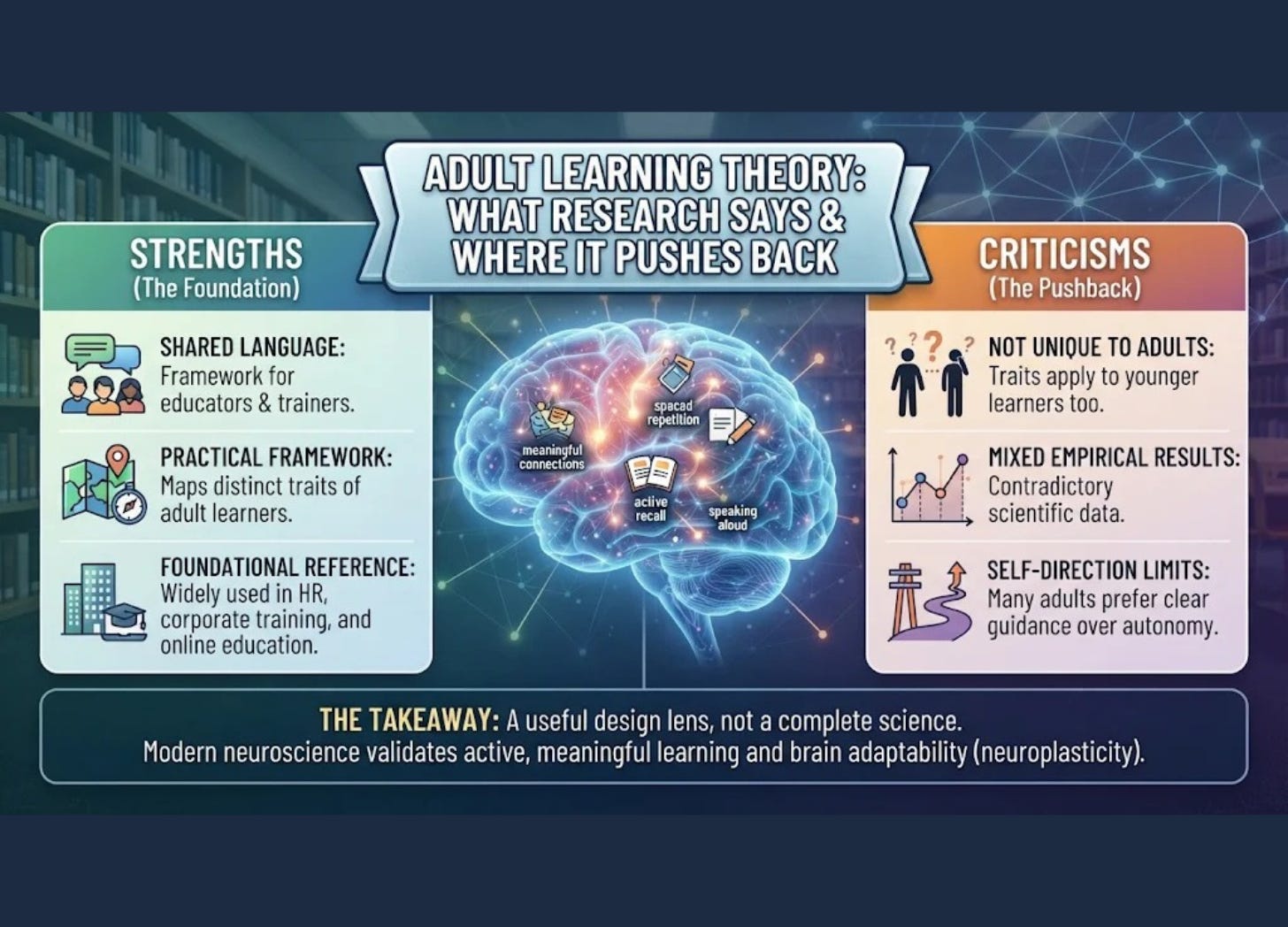
Adult learning theory is hugely influential, yet it is also contested. Any fair guide should look at both sides.
Its biggest strength is that it gave educators a shared language for something many already sensed intuitively. Andragogy was the first model to map out the distinct traits of adult learners and offer a practical framework for responding to them. Decades later, it remains a foundational reference point across adult education, human resource development and online learning. [onlinelibrary.wiley.com]
At the same time, researchers have raised fair criticisms. One recurring argument is that these traits aren’t strictly unique to adults, as plenty of teenagers and children learn better when they understand the purpose behind a lesson. Another issue is that empirical testing of andragogy has produced mixed and sometimes contradictory results. Critics also point out that self-direction is far from universal. Plenty of adults actually want clear structure and step-by-step guidance, especially when tackling a subject from scratch. [eric.ed.gov] [files.eric.ed.gov] [tandfonline.com]
The honest takeaway is that adult learning theory is a helpful design lens rather than a complete science of the brain. It tells you what adults generally prefer, even if it can’t predict how every individual in a room will behave.
Where modern science backs Knowles up strongly is on the value of active, effortful learning. Neuroscience has shown that the adult brain stays adaptable throughout life, physically reshaping connections between neurons when we practice new skills. Long-term memory sticks through spaced repetition and active recall, such as closing your notes and explaining a concept out loud from memory. Learning also embeds much faster when it feels meaningful and tied to personal goals, which aligns neatly with the spirit of Knowles’ work even where it complicates his simpler claims. [epale.ec.europa.eu]
Three principles you can use today
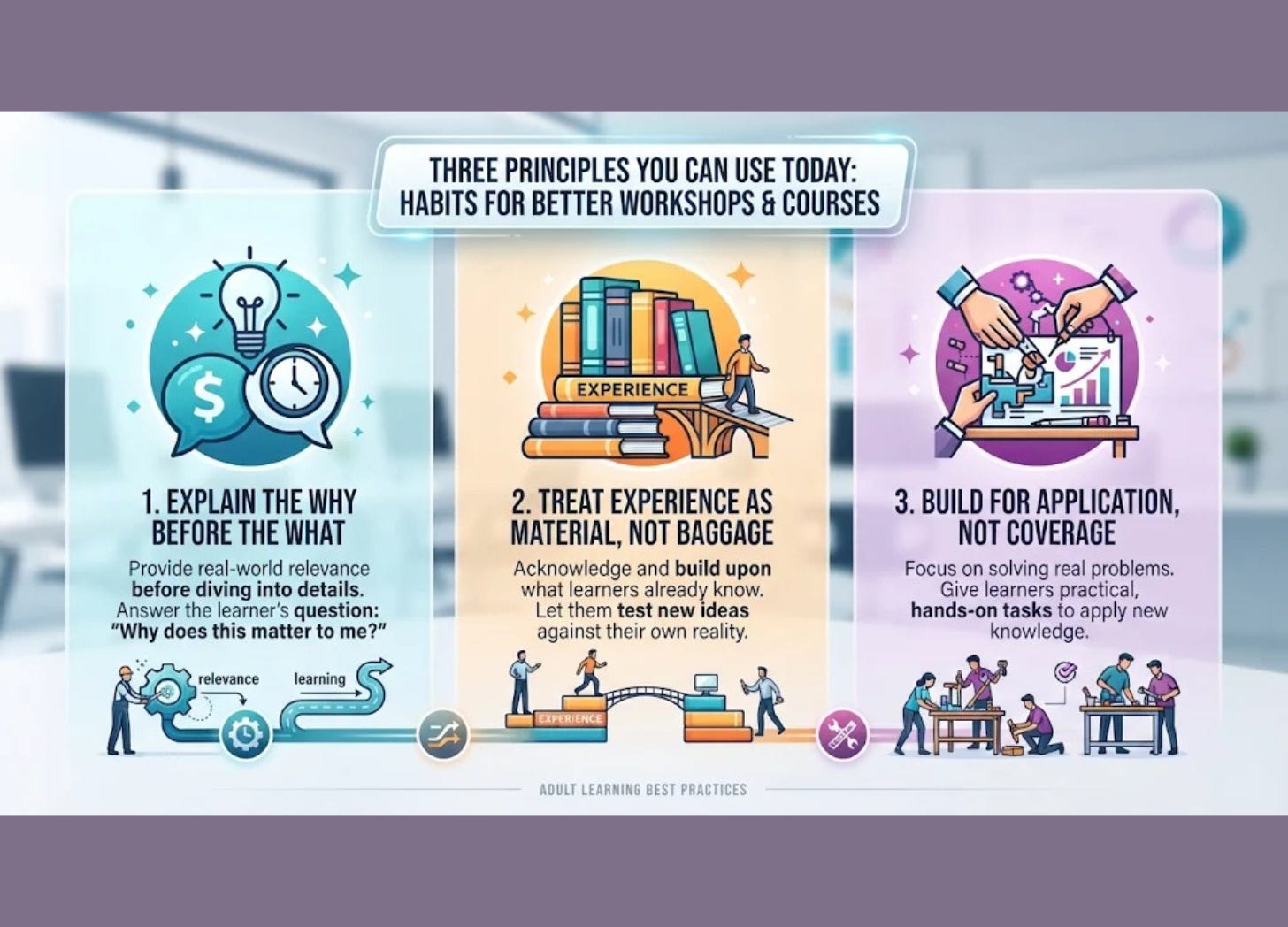
You don’t need to memorise all six assumptions to run a better workshop or write a stronger course. Start with these three habits instead.
1. Explain the why before the what. Before teaching a single concept, answer the learner’s silent question: Why does this matter to me right now? A single sentence of real-world relevance at the start of a session does more heavy lifting than an hour of content delivered without context.
2. Treat experience as material, not baggage. Ask adults what they already know, build on it and let them test new ideas against their own reality. When old habits get in the way, name that friction gently rather than pretending you are starting with a blank slate.
3. Build for application, not coverage. Resist the urge to cram every piece of information into a slide deck just to say you covered it. Design your session around a real problem people face and give them something practical to do with the information before they leave. Adults remember what they actually use.
The short version
Adult learning theory isn’t a magic formula. It is simply a reminder that grown-ups are not oversized children. We want clear reasons, basic respect and learning that connects to our actual lives.
Knowles gave those instincts a name and decades of research have refined the finer details. Still, the core insight holds up: if you design learning for adults as capable peers, you will get far better results than if you treat them like empty vessels waiting to be filled.